
Luca Giuliani, Dr. phil.
Rektor des Wissenschaftskollegs (2007–2018), Professor (em.) der Klassischen Archäologie
Humboldt-Universität zu Berlin
Geboren 1950 in Florenz, Italien
Studium der Klassischen Archäologie, Ethnologie und Italienischen Literaturwissenschaft an der Universität Basel und an der Ludwig-Maximilians-Universität München
Arbeitsvorhaben
A Face for Socrates: The Making of Ancient Greek Portraits
This is the title of a book that I am writing in collaboration with Maria Luisa Catoni (Fellow 2009/2010), to be published by Oxford University Press in 2026. It deals with the portrait that was dedicated to Socrates’ memory by friends or pupils, sometime after he had been tried and executed, but before his official rehabilitation—at a time when he was still considered a public criminal. We have already published papers on this subject. Writing a monograph now forces us to widen the scope and to examine the tradition of ancient Greek portraiture in general. This means also to revisit the most relevant scholarship on the subject, which is strongly rooted in a very specific German culture, highly sophisticated and at the same time deeply dated. Complex problems sometimes become easier to manage when you look at them from far away. In our case, the necessity to address a wider English audience, while at the same time keeping our text brief and clear, has helped us to gain a new perspective. We are now beginning to see the outlines of a theory of ancient portraiture as being both similar to and profoundly different from its modern counterpart, with the portrait of Socrates at its centre.Recommended Reading
Catoni, Maria Luisa, and Luca Giuliani. “Socrates Represented: Why Does He Look Like a Satyr?” Critical Inquiry 45 (Spring 2019): 681–713. https://doi.org/10.1086/702595.
—. “Der verurteilte Philosoph, die Satyrn und das Hässliche: Das frühe Sokrates-Porträt im Kontext.” Jahrbuch des Deutschen Archäologischen Instituts 136 (2021): 151–197.
Kolloquium, 03.03.2026
Ancient Greek portraiture and recognition: The case of Pindar
[[Over the past few years, I have been working about the portrait of the Athenian philosopher Socra-tes, in cooperation with a former Fellow, Maria Luisa Catoni. This project is now coming to an end; the book will be published by Oxford UP. Socrates was already old when, in 399 BCE, the Athenians accused him of impiety and of corrupting the young; a trial followed, and Socrates was convicted and put to death. About one generation later, when Socrates was still considered a public criminal, a portrait to his memory was commissioned, most likely by friends and followers. The bronze original of the portrait is lost, but we have some Roman copies. They show that the philosopher was depicted as a satyr – an astonishing decision that poses a series of interesting questions. However, in this Colloquium I shall not speak about Socrates. I would rather like to reflect about some general peculiarities of ancient Greek portraiture]].
In Greek, there is no precise equivalent for our concept of portrait (ritratto, likeness). The Greek word eikṓn, first attested around the middle of the 5th century BCE, is used for statues and paintings of individual persons; but it can also mean image in a general sense and can be a figure of speech, like a simile. Its meaning is too broad. This is why, speaking about ancient phenomena, I use the modern term portrait. But we have to be careful. Using this term, I simply mean the depiction of a specific person, living or having lived. I do not imply that what I call a portrait would necessarily aim at achieving recognizability of the person depicted by means of some kind of physiognomic resemblance. Many Western portraits since the late Middle Ages do exactly this, of course – but many ancient portraits do not; actually, before the middle of the 5th century BCE, they never do.
In order to understand the history of Greek portraiture, it is useful to distinguish between typological and individualizing portraits. I shall begin with the typological tradition. These portraits depict a specific person as a blameless member of a given social group. Blamelessness implies conformity to accepted norms and the absence of distinctive, deviating traits. Typological portraits of members of the same group will tend to look very similar to each other. What makes the depicted person identifiable is only the name inscription. Individualizing portraits, on the contrary, focus on distinctive traits, trying to mark an individual as unmistakable and recognizable. Such portraits emerge towards the middle of the 5th century BCE: they consciously deviate from the typological tradition, moving in a new direction. At first, individualizing portraits were rare exceptions, while the typological tradition remained dominant; it took decades for the former to become more frequent and finally to proliferate.
The first specimen of individualizing portrait that we can grasp is the portrait of Pindar. We shall use this portrait as a test case, trying to understand the chances and risks of individualizing portraiture in general (without forgetting the important differences between ancient individualizing portraits and modern likenesses).

Köpfe und Ideen 2018
„Die Gruppe ist am Ende eines Jahres jugendlicher ...“
Luca Giuliani im Interview mit Lothar Müller
Publikationen aus der Fellowbibliothek
Giuliani, Luca (2016)
Michelangelos Quader : ein Nachtrag
Giuliani, Luca (Basel, 2015)
Das Wunder vor der Schlacht : ein griechisches Historienbild der frühen Klassik Jacob-Burckhardt-Gespräche auf Castelen ; 30
Giuliani, Luca (2015)
How id the Greeks translate traditional tales into images?
Giuliani, Luca (Ērakleio, 2014)
Aristurgēmata tēs archaias technēs griech., neugriech.::Meisterwerke der antiken Kunst
Giuliani, Luca (2013)
Giuliani, Luca (2013)
Sarcofagi di Achille tra oriente e occidente : genesi di un'iconografia
Giuliani, Luca (S.l., 2013)
Routi haishi shitou - Mikailangqiluo de Loulunzuo Meidiqi mudiao Fleisch oder Stein - Michelangelos Grabstatue des Lorenzo de Medici <chin.>
Giuliani, Luca (2013)
Giuliani, Luca (München, 2013)
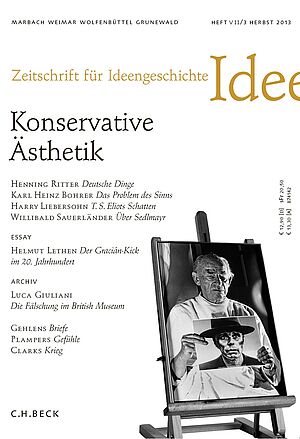
Konservative Ästhetik Zeitschrift für Ideengeschichte ; 7.2013,3
Giuliani, Luca (Göttingen, 2013)
Possenspiel mit tragischem Helden : Mechanismen der Komik in antiken Theaterbildern Historische Geisteswissenschaften ; 5
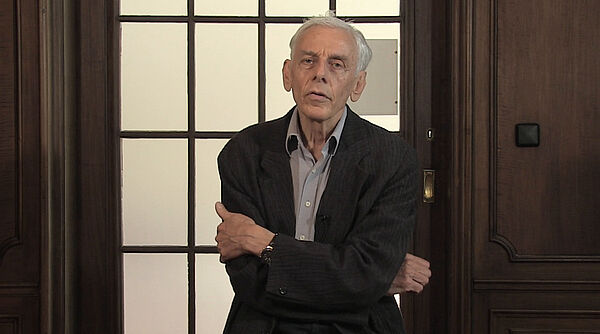

Lectures & Keynotes 25.11.2012

Fleisch oder Stein? Zu Michelangelos Grabstatue des Lorenzo Medici

Workshop (Convener) 06.06.2019
Das Aufkommen narrativer Bilder in vergleichender Perspektive
Workshop (Convener) 30.10.2014
Cultural Variation: A Workshop on Historical Methodology


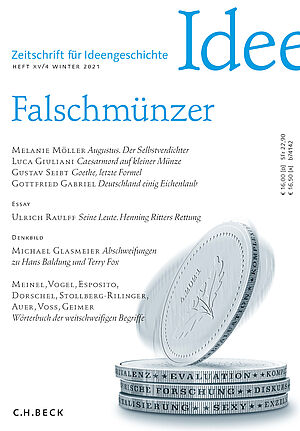



Veranstaltungen
Luca Giuliani
Luca Giuliani
Luca Giuliani | Benjamin Oldroyd | Bénédicte Zimmermann
Luca Giuliani
Luca Giuliani | Veronika Tocha
Luca Giuliani
Luca Giuliani
Luca Giuliani | Susanne Muth
Luca Giuliani
Luca Giuliani
Luca Giuliani
Luca Giuliani | Franco Moretti
Luca Giuliani | Franco Moretti
Luca Giuliani