
Lorraine J. Daston, Ph.D.
Direktorin em.; Professorin, Committee on Social Thought
Max-Planck-Institut für Wissenschaftsgeschichte, Berlin
Universität Chicago
Geboren 1951 in East Lansing, Mich., USA
Studium der Geschichte, Philosophie, Mathematik und Wissenschaftsgeschichte in Cambridge und in Harvard
Arbeitsvorhaben
Thinking with Natural Disasters
There has never been a time without disasters: sudden eruptions of concentrated destruction and suffering, death and devastation on a grand scale. The annals of human history are stained with the records of such events; indeed, the prototype of what counts as a historical event worth reporting and recording, from the earliest chronicles to yesterday’s newspaper headline, is the disaster—whether an earthquake, a bloody war, an epidemic, an infestation of rats, a flood, or any of the other misfortunes that can befall a community. Disasters intensify experience, rupture the continuity between past and present, and make a mockery of human plans and promises. More than just memorable events that take their place alongside revolutions and dynasties in chronicles, disasters define what an event is: an unexpected explosion that bursts into the smooth sameness of the everyday. In the most ancient records and in many cultures, disasters punctuate the prose of history like exclamation points.In the very long history of disasters, there are occasionally moments when disasters are radically rethought—their causes, their meaning, their implications for how we do live and how we should live. These moments are rare, but when they occur, they transform more than just ideas about disasters. So fundamental are disasters to human experience that rethinking them also entails rethinking bedrock ideas about metaphysics, ethics, and history. Who or what makes things happen in the world, and who or what is responsible when, from a human perspective (and a disaster is by definition always from the human perspective), things go very badly wrong?
We are once again in the midst of such a moment. The category of the natural disaster is disappearing before our eyes, and with it, an ethics of blameless evil, beyond human meaning, and a metaphysics of autonomous nature, beyond human will. Thinking with Natural Disasters will be a book about these rare historical moments, using thinking about disasters to trace seismic changes in how we make sense of the world.
Recommended Reading
There has never been a time without disasters: sudden eruptions of concentrated destruction and suffering, death and devastation on a grand scale. The annals of human history are stained with the records of such events; indeed, the prototype of what counts as a historical event worth reporting and recording, from the earliest chronicles to yesterday’s newspaper headline, is the disaster—whether an earthquake, a bloody war, an epidemic, an infestation of rats, a flood, or any of the other misfortunes that can befall a community. Disasters intensify experience, rupture the continuity between past and present, and make a mockery of human plans and promises. More than just memorable events that take their place alongside revolutions and dynasties in chronicles, disasters define what an event is: an unexpected explosion that bursts into the smooth sameness of the everyday. In the most ancient records and in many cultures, disasters punctuate the prose of history like exclamation points.
In the very long history of disasters, there are occasionally moments when disasters are radically rethought—their causes, their meaning, their implications for how we do live and how we should live. These moments are rare, but when they occur, they transform more than just ideas about disasters. So fundamental are disasters to human experience that rethinking them also entails rethinking bedrock ideas about metaphysics, ethics, and history. Who or what makes things happen in the world, and who or what is responsible when, from a human perspective (and a disaster is by definition always from the human perspective), things go very badly wrong?
We are once again in the midst of such a moment. The category of the natural disaster is disappearing before our eyes, and with it, an ethics of blameless evil, beyond human meaning, and a metaphysics of autonomous nature, beyond human will. Thinking with Natural Disasters will be a book about these rare historical moments, using thinking about disasters to trace seismic changes in how we make sense of the world.
Recommended Reading
Daston, Lorraine. Rules: A Short History of What We Live By. Princeton University Press, 2022.
Kolloquium, 07.07.2006
Diversity as a Value: A History
It is startling to realize how quickly and thoroughly the value of diversity, until a few decades ago a value largely confined to the aesthetic and organic realms, has acquired deep political and moral significance. Universities, corporations, and governments are now judged by the degree to which they achieve diversity among their leaders and recognize diversity among their publics. Older values of the liberal polity, for example that of honoring merit without regard to creed, race, sex, or ethnicity, have been increasingly eclipsed by values that closely attend to these and other differentiating traits (which traits matter is contentious). How did this sea change in value come about, and come about so swiftly? And what kind of value is diversity? The long history of diversity as an aesthetic and economic value helps explain the recent rapid rise of diversity as a moral and political value. More generally, the case of the wandering value of diversity reveals how fluid the boundaries between what we usually think of as distinct normative realms can be.
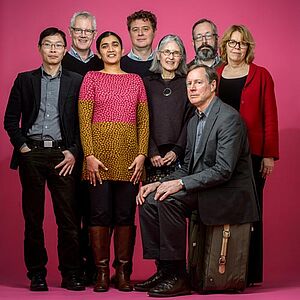
Köpfe und Ideen 2014
Zwei mal drei macht vier, widewidewitt und drei macht neune ...
ein Porträt von Wendy Espeland, Jahnavi Phalkey, Theodore M. Porter, Lorraine J. Daston, Tong Lam, John Carson von Jürgen Kaube
Publikationen aus der Fellowbibliothek
Daston, Lorraine J. (New York, NY, 2023)
Rivals : how scientists learned to cooperate
Daston, Lorraine J. (Princeton, 2022)
Rules : a short history of what we live by The Lawrence Stone lectures
Daston, Lorraine J. (Berlin, 2018)
Gegen die Natur Against nature
Daston, Lorraine J. (Chicago, 2017)
Science in the archives : pasts, presents, futures
Daston, Lorraine J. (Jerusalem, 2015)
Before the two cultures : big science and big humanities in the nineteenth century Proceedings / The Israel Academy of Sciences and Humanities ; Vol. 9, No. 1
Daston, Lorraine J. (Chicago, Ill. [u.a.], 2013)
How reason almost lost its mind : the strange career of Cold War rationality
Daston, Lorraine J. (Berlin, 2012)
Festkolloquium für Hans-Jörg Rheinberger : Beiträge zum Symposium am 24. 1. 2011 im Max-Planck-Institut für Wissenschaftsgeschichte Preprint ; 433
Daston, Lorraine J. (2012)
Wissenschaftsgeschichte und Philosophie : Hans-Jörg Rheinberger und l'esprit de la fleuve
Daston, Lorraine J. (2011)
The empire of observation, 1600-1800
Daston, Lorraine J. (Chicago, 2011)
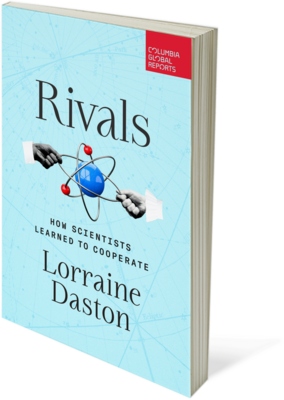
Im Kolleg entstanden 17.10.23
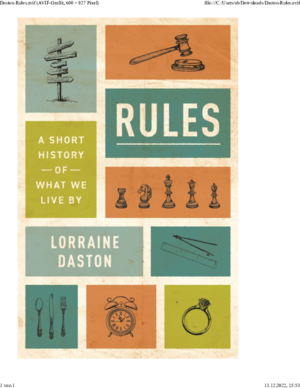
Im Kolleg entstanden 12.07.22

Veranstaltungen
Lorraine J. Daston
Lorraine J. Daston
Lorraine J. Daston | David B. Oppenheimer
Lorraine J. Daston
Lorraine J. Daston
Teresa Castro Martín | Lorraine J. Daston | Mark E. Hauber | Anthony Ossa-Richardson
Minou Arjomand | Johannes Böhme | Lorraine J. Daston | Magdalena Waligórska
Lorraine J. Daston | George E. Lewis | Yossi Yovel
Lorraine J. Daston
Lorraine J. Daston
Lorraine J. Daston | Raghavendra Gadagkar
Lorraine J. Daston
Lorraine J. Daston
Lorraine J. Daston
Lorraine J. Daston