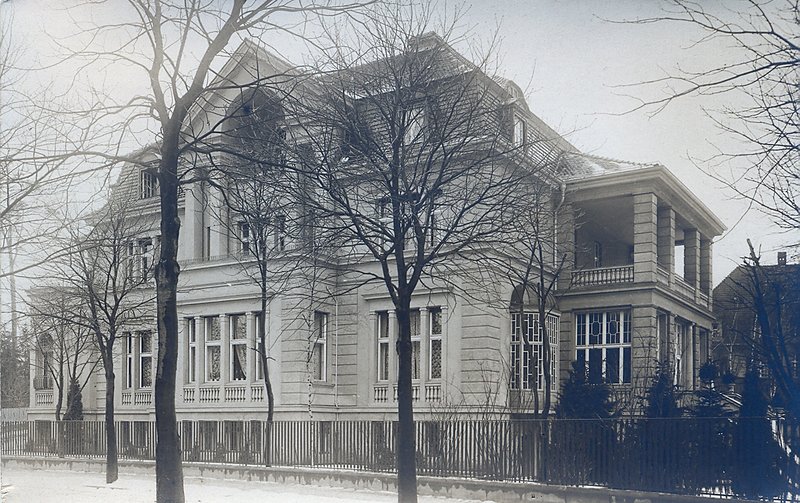
The grounds are a park-like garden typical of the Grunewald’s villa colony in the period from 1890 to 1920.
Noteworthy here are both the garden’s artistic and landscaping features. After considerable changes were carried out beginning in the 1930s, enactment of a preservation order in July 1984 restored the original landscaping to the grounds ? involving the tearing down of garages, reconstruction of old pathways and their surfaces, repair of the various small “squares”, and the planting of flowerbeds. All trees and shrubbery that had not been provided for in the original plans were removed so as to clear the view to the nearby lake, the Halensee. Access to the lake, beyond the garden gate, is under the administration of Berlin’s Wilmersdorf district.
In Wilmersdorf’s official record of its historical monuments the following is stated: “The central area of this villa-garden has been largely preserved its original structure. The garden is an outstanding example of garden landscaping among the German upper middle class in the Wilhelmine era, a style characterized by careful attention to details in the landscaping design as well as to spatial-artistic components. Certain of the historical elements have been preserved, such as the garden gate area, the wrought-iron fence, and the original layout of vegetation. There is a magnificent staircase leading to the banks of Halensee, with a terrace-like seating arrangement and a wonderful view out over the lake.”
Originally commissioned by the Berlin Senator for Civic Development and Environ-mental Protection, the following report gives a detailed description of Wallotstraße 19:
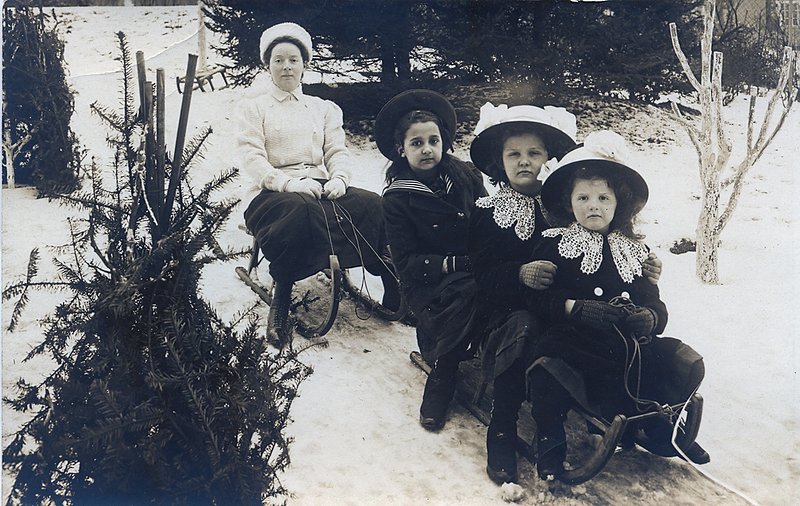
“The entire grounds encompass 4,775 square meters. Occupying the villa was the family of Dr. Linde as well as their gardener, porter, and nursemaid. A large chicken coop was incorporated on the southwest side, the sunken courtyard affording room for the dogs to run around. On the north side was a children’s playground equipped with gymnastic apparatus ? a rope, pole, horizontal bar, rings, and a swing. On the western border of the grounds, atop a rise, was an undersized brick-dust tennis court. A picket fence on the upper edge of the embankment had dog roses and vetches clinging to it; below the fence, on the embankment itself, were raspberry and currant bushes.
The northern border of the grounds was planted with numerous trees and thick shrubbery that gave it a woodsy character. In certain sections the shrubbery consisted entirely of varying kinds of lilacs. On the same level as the tennis court, under a trio of birch trees, was one of five circular seats. The seating area in front of the large flight of stairs had a diameter of twelve meters and was decorated with four palms (circa two meters tall) in containers.
Right next to the stairs was a little goldfish pond that was replenished by means of a water pipe in the wall. Flanking the pond were two small flowerbeds with flowering shrubbery of medium-high growth (presumably guelder rose).
Near the flight of stairs was an abundance of rhododendrons that blossomed in early summer, and mixed in with them were laurel and fir trees. Apple, pear, and plum trees adorned the grassy area to the northwest.
Directly in front of the stairs was an oval section of lawn and, about half a meter below it, a bed of roses with a seating arrangement in the form of a half circle; this was augmented with a planter mounted on a pedestal.
From another seat one’s eye rejoiced in the colorful prize, bush and long-stem roses. Between the box-tree hedge and the boat landing, a rock garden with alpine flora ran down to Halensee. Phlox and hortensia adorned the fork in the road at the big roundabout, which encircled a lawn with a large copper beech tree. Adjacent was another seat shaded by a weeping willow.
On the ground’s eastern edge, bordering the neighboring lot, was the vegetable garden with greenhouse flowerbeds and a compost heap. The Wallotstraße side of the grounds was lightly sprinkled with trees and ornamental shrubs ? chestnuts, acorns, firs, poplars, lilacs, forsythia, mock orange, laburnum, weigela, and snowberries.
In the entrance area, a gravel path divided the lawn into two halves. The annual flower-bed planting yielded the period’s typical spring and summer flowers ? pansies, forget-me-nots, and begonias.
The paths were bordered by yellow-red clinker brick and strewn with yellow gravel. All the steps in the garden were constructed from wooden planks.
Along with the aforementioned planters, the garden was also spotted with diverse furniture ? white wooden pieces, iron benches and chairs with wooden seats, cane tables and chairs, as well as seats fashioned by the gardener from birchwood ? and a stone sculpture of the goddess of victory (an heirloom of Erna Linde’s parents) that was set up at the confluence of the sloping path and the oval.
The grounds were set off from Wallotstraße by a five-foot iron lattice fence atop a half-meter-high wall; access was provided by two gates, one at the main entrance and another adjacent to the vegetable garden. A simple chain-link fence delimited those areas bordering on neighboring lots and on the banks of the lake.
Noteworthy is a pipe that runs along the boundary contiguous with the plot of land belonging to Wallotstraße 17. This pipe is a subterranean lake trench (“Hohlenseegraben”) and sole link between Halensee and Koenigsee.”
Reinhart Meyer-Kalkus