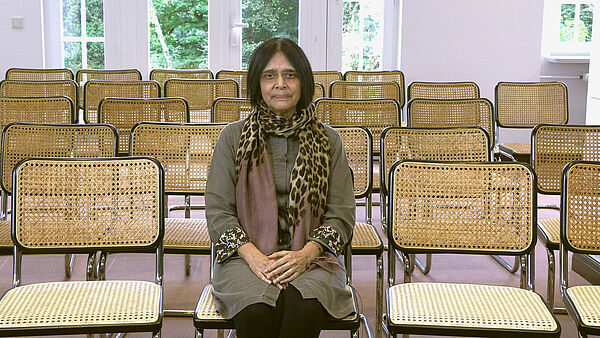
Rohini Balakrishnan, Ph.D.
Professor of Ecology
Indian Institute of Science, Bengaluru
Born in 1963 in Mumbai, India
B.Sc. in Zoology, Bangalore University, M.Sc. in Zoology, Poona University, Ph.D. in Behaviour Genetics, Tata Institute of Fundamental Research, Bombay
Project
Cricket Scores: Singers and Listeners (A Tinbergian Synthesis of Cricket and Katydid Acoustic Communication)
Crickets and katydids are among the oldest terrestrial insects to have evolved acoustic communication for mate-finding. They show a bewildering diversity of signals and mate-finding strategies, across and within species and communities. My work tries to understand why signals are structured the way they are, when and where animals signal, and what drives these decisions. Equally important are decisions that receivers make based on these signals, on whom to approach or avoid, when, how, and whether to search for mates. I have examined these questions using a variety of approaches, from understanding the physics and physiology of signalling to the influence of immediate ecological context and evolutionary history. I have also examined the fitness consequences of these decisions. The empirical data have yielded many unexpected results, challenging some common assumptions in the area of animal communication. In this project, I would like to synthesise these findings on signalling and decision-making in the form of a book placed in the wider perspective of the field of animal communication. I believe that there is necessity at this point for a deeper reflection on the entrenched assumptions and approaches to the study of animal communication, how these limit our understanding, and how we may move forward. This is of particular significance when trying to understand anthropogenic impacts on animal communication. This book will also examine more broadly the historical trajectory of animal behaviour research and how anthropomorphism and human perception may have biased this trajectory.Recommended Reading
Jain, Manjari, Swati Diwakar, Jimmy Bahuleyan, Rittik Deb, and Rohini Balakrishnan (2014). “A Rain Forest Dusk Chorus: Cacophony or Sounds of Silence?” Evolutionary Ecology 28: 1–22. https://doi.org/10.1007/s10682-013-9658-7.
Raghuram, Hanumanthan, Rittik Deb, Diptarup Nandi, and Rohini Balakrishnan (2015). “Silent Katydid Females Are at Higher Risk of Bat Predation than Acoustically Signalling Katydid Males.” Proceedings of the Royal Society B 282: 20142319. https://doi.org/10.1098/rspb.2014.2319.
Deb, Rittik, Sambita Modak, and Rohini Balakrishnan (2020). “Baffling: A Condition-Dependent Alternative Mate Attraction Strategy Using Self-Made Tools in Tree Crickets.” Proceedings of the Royal Society B 287: 20202229. https://doi.org/10.1098/rspb.2020.2229.
Colloquium, 03.12.2025
Cricket Songs: Singers and Listeners
Crickets are singing insects and the first known terrestrial animals to communicate using sounds. Male crickets sing to attract females of their species as potential mates. Females are silent but hear, recognize, and navigate towards male songs from a distance. In addition to females of their species, cricket songs have attracted the attention of eavesdropping predators, as well as humans. Humans have engaged with crickets over centuries in a cultural context and, more recently, with them as subjects of scientific inquiry. I will summarize my preliminary findings and thoughts on human-cricket interactions in the cultural context and then move on to a couple of scientific case studies from my work on the how and why of acoustic communication in crickets. I will describe my findings on the relative predation risk of singing males versus silent, searching females in the broader context of examining what determines the roles that males and females assume during mate-finding. In the second case study, I will discuss how crickets communicate effectively in noisy environments and the role that senders, receivers, and the messages themselves play in achieving clear, unambiguous communication. I will end with some illustrative examples of how crickets, with their small brains, solve complex computational problems and exhibit sophisticated behaviours commonly associated with larger vertebrates.
Publications from the Fellow Library
Balakrishnan, Rohini (London, 2025)
Acoustic monitoring for tropical insect conservation
Balakrishnan, Rohini (Berlin, 2023)
Is flying riskier for female katydids than for males?
Balakrishnan, Rohini (London, 2023)
Multimodal duetting in karydids under bat predation risk : a winning strategy for both sexes
Balakrishnan, Rohini (Lausanne, 2022)
Ecological constraints on sexual selection in a human-modified landscape
Balakrishnan, Rohini (Cambridge, 2021)
Balakrishnan, Rohini (London, 2020)
Balakrishnan, Rohini (Basel, 2017)
Tree crickets optimize the acoustics of baffles to exaggerate their mate-attraction signal
Balakrishnan, Rohini (Berlin, 2015)
Ecology of acoustic signalling and the problem of masking interference in insects
Balakrishnan, Rohini (Cambridge, 2015)
A novel acoustic-vibration multimodal duet
Balakrishnan, Rohini (Oxford, 2014)
The opportunity for sampling: the ecological context of female mate choice