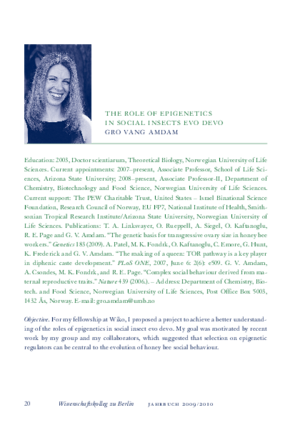
Gro Vang Amdam, Dr.
Professorin für integrative Neurowissenschaften und Evolutionsbiologie
Norwegian University of Life Sciences, Ås
Geboren 1974 in Norwegen;
Studium der Theoretischen Regulierungsbiologie an der Norwegian University of Life Sciences
Schwerpunkt
Soziale Insekten als Soziale Insekten als Modellsystem für die Evolutionäre EntwicklungsbiologieModellsystem für die Evolutionäre Entwicklungsbiologie
Arbeitsvorhaben
Die Lebensgeschichte als Grundriss für die Evolutionsbiologie sozialer Insekten
Recent work from my group and collaborators suggests that selection on major life history regulators may have been central to evolution of insect social behavior. By defining a "ground plan" of co-regulated traits, these systems can contribute to predictable variation in social phenotypes and serve as substrates for selective breeding.I would like to mature these hypotheses into a heuristic framework that describes my ideas on the mechanisms of the "ground plan". This framework will allow the focus group to expand its explanatory models to include specific candidate regulators. I believe this extended insight can change our understanding of how social behavior can emerge.
Recommended Reading
Linksvayer, T. A., O. Rueppell, O. Kaftanoglu, R. E. Page, and G. V. Amdam. 2009. "The genetic basis for transgressive ovary size in honey bee workers." Genetics, in press.
Patel, A., K. F. Fondrk, O. Kaftanoglu, C. Emore, G. Hunt, K. Frederick, and G. A. Amdam. 2007. "The making of a queen: TOR pathway is a key player in diphenic caste development." PLoS ONE 6: e509. Featured in Nature, Research highlights.
Amdam, G. V., A. Csondes, M. K. Fondrk, and R. E. Page. 2006. "Complex social behaviour derived from maternal reproductive traits." Nature 439: 76-78.
Publikationen aus der Fellowbibliothek
Amdam, Gro Vang (Cold Spring Habor, 2022)
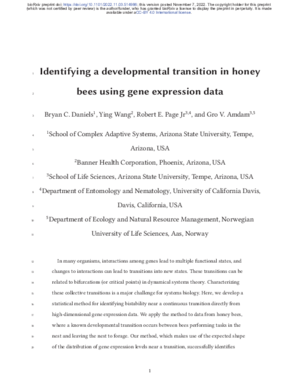
Identifying a developmental transition in honey bees using gene expression data
Amdam, Gro Vang (Chicago, Ill., 2013)
Life-history evolution and the polyphenic regulation of somatic maintenance and survival
Amdam, Gro Vang (London, 2012)
Amdam, Gro Vang (Cambridge, 2012)
Regulation of behaviorally associated gene networks in worker honey bee ovaries
Amdam, Gro Vang (San Francisco, California, US, 2011)
Amdam, Gro Vang (Oxford [u.a.], 2011)
Social context, stress, and plasticity of aging
Amdam, Gro Vang (Oxford, 2011)
Amdam, Gro Vang ([Berlin?], 2011)
Genetic architecture of ovary size and asymmetry in European honeybee workers
Amdam, Gro Vang (San Francisco, California, US, 2011)
Amdam, Gro Vang (2011)
Honey bee life history plasticity : development, behavior, and aging
Im Kolleg entstanden 07.11.22