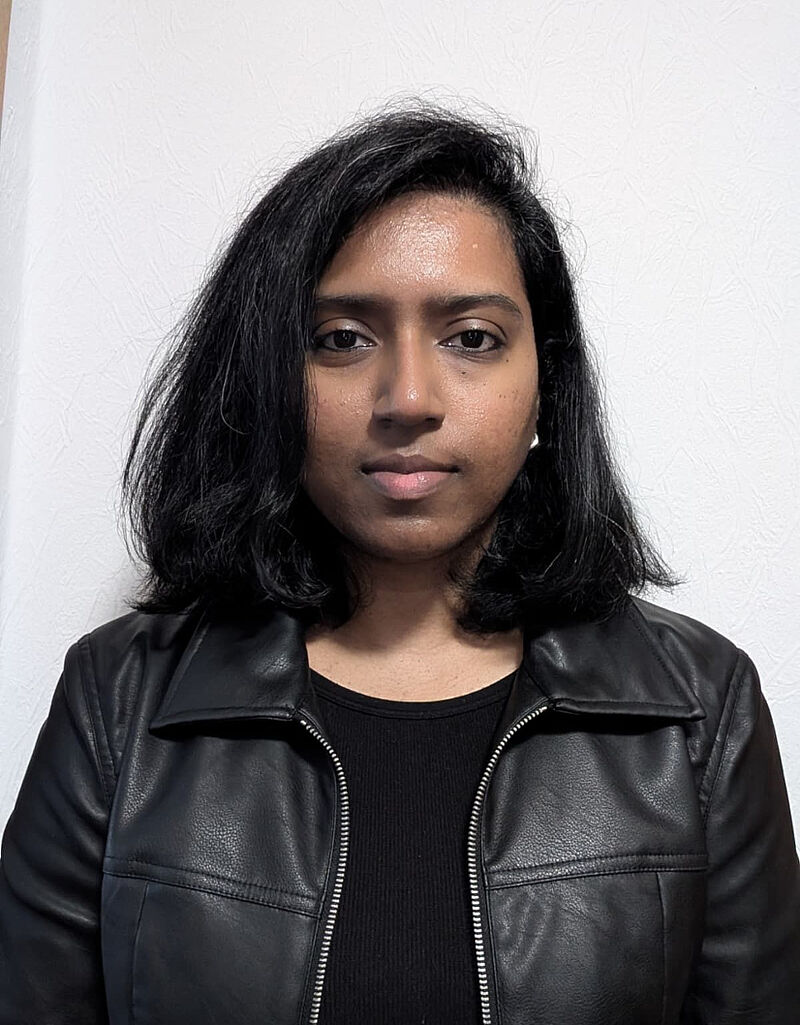
Revathe Thillaikumar, Ph.D.
Marie Sklodowska-Curie Actions Postdoctoral Fellow
Max-Planck-Institut für Verhaltensbiologie, Konstanz
from February to June 2027
Born in 1992 in Madurai, India
B.Tech. in Biotechnology, Anna University, Chennai, Ph.D. in Evolutionary and Organismal Biology, Jawaharlal Nehru Centre for Advanced Scientific Research
Fellowship
College for Life Sciences
Arbeitsvorhaben
Rethinking Animal Culture Using Elephants as the Model Organism
During my stay at the Wissenschaftskolleg, I aim to develop research ideas that address fundamental gaps in our understanding of animal culture, using elephants as the model species.I will explore the contributions of multiple cultural transmission mechanisms: Humans learn by engaging multiple, if not all, senses at once. For example, children learn the affordances of their environment through multisensory exploration during early development. Despite the importance of multiple senses for learning routine skills, studies of animal culture have long focused on singular modalities (vision or sound) when investigating social transmission of information. Elephants are an excellent model organism to go beyond the commonly studied modalities due to their everyday reliance on advanced olfactory and tactile senses (delivered via the trunk) in addition to vision and sound, for social and subsistence activities. I will develop a framework that can be used to tease apart the contributions of different sensory modalities to social learning of information in elephants, which can subsequently be applied to other species.
I will use human cultural products to understand elephant culture: Because elephants occupy a prominent space in human culture, our observations of them span centuries and appear in sources such as cave art, folklore, and literary texts. Can this wealth of information about elephants’ behaviours, range, and habitat be considered data? I plan to collaborate with literary experts and cultural archaeologists to develop a methodology for the behavioural ecological investigation of the historical records of elephants.
These planned projects aim to reshape our understanding of animal culture by 1. introducing a new model organism, 2. elucidating the role of diverse cultural transmission mechanisms, and 3. leveraging supplementary methodological approaches. I believe these topics will interest other Fellows, and I look forward to engaging in fruitful discussions and collaborations with them and with institutions in Berlin.
Recommended Reading
Thillaikumar, Revathe, Roger Mundry, Sri Suci Utami-Atmoko, et al. (2025). “Sumatran Orangutan Mothers Differ in the Extent and Trajectory of their Expression of Maternal Behaviour.” Proceedings of the Royal Society B 292 (2046): 20250443. https://doi.org/10.1098/rspb.2025.0443.
Thillaikumar, Revathe, and T.N.C. Vidya (2026). “Young Asian Elephant Calves Show Differentiated Social Relationships with Conspecifics.” Ethology 132 (4): 248–262. https://doi.org/10.1111/eth.70048.
Thillaikumar, Revathe, Marie-Theres Weidling, Sri Suci Utami-Atmoko, et al. (2026). “Eight Years of Social and Individual Learning Jointly Drive Ecological Competence in Orangutans.” Preprint, bioRxiv, April 27. https://doi.org/10.1101/2025.08.27.672553.
Publikationen aus der Fellowbibliothek
Thillaikumar, Revathe (Oxford, 2026)
Young asian elephant calves show differentiated social relationships with conspecifics
Thillaikumar, Revathe (Cold Spring Harbor, 2026)
Eight years of social and individual learning jointly drive ecological competence in orangutans