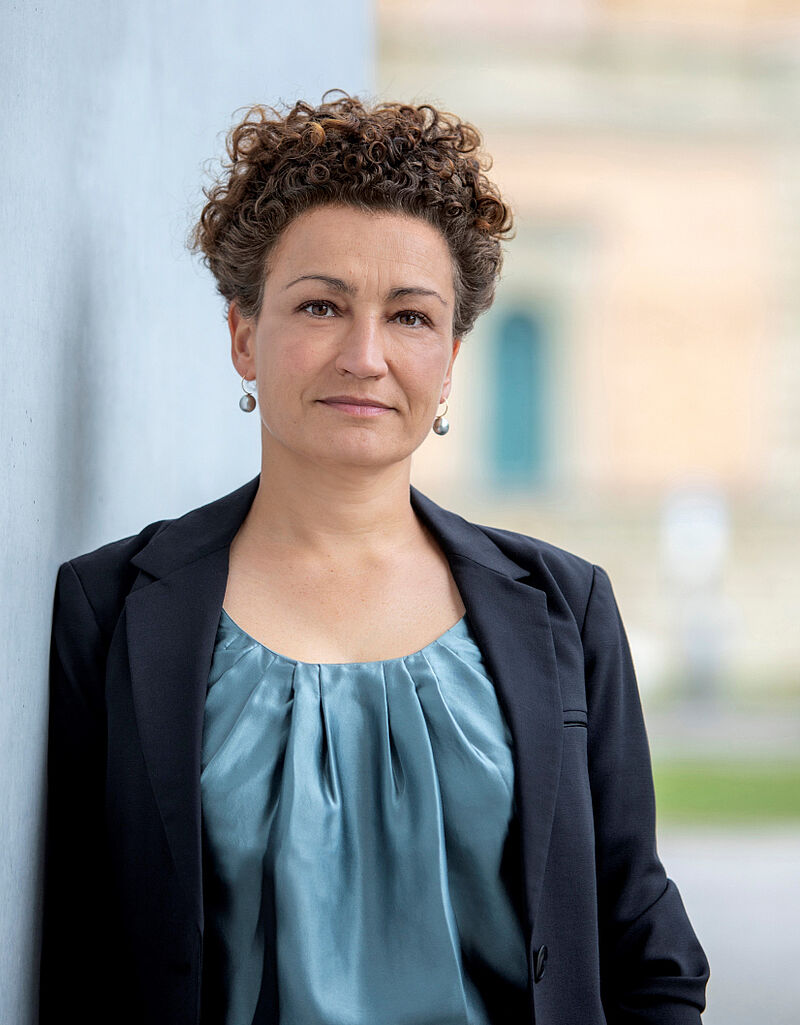
Rubina Raja, DPhil
Professor of Classical Archaeology and Art
Universität Aarhus
Born in 1975 in Hørsholm, Denmark
BA in Classical Archaeology, University of Copenhagen, MSt in Classical Archaeology and DPhil in Classical Archaeology, University of Oxford, Master of Public Governance, Copenhagen Business School
Arbeitsvorhaben
Religion and Urbanity in Ancient Palmyra (Syria)
The evidence for urban religious practices at Palmyra is broad, ranging from monumental sanctuaries to altars, to religious reliefs and sculpture, to inscriptions. However, the visual representations of Palmyrene priests, distinctly recognisable through their priestly hat—round with a flat top—constitute the largest group of evidence testifying to the local religious life in the Roman period (1st–3rd c. CE). There are plentiful representations of Palmyrene priests in Palmyrene iconography, in particular funerary sculpture and so-called banqueting tesserae. Close to six hundred of these exist in the corpus of the funerary limestone sculpture and about five hundred in the corpus of the tesserae. While these representations are repetitive in many ways, in that they show male Palmyrenes dressed in priestly clothes, they also differ in the detail and unique expressions adapted by the individual to express their societal status. This monograph project will address the entire corpus of Palmyrene priestly representations, the epigraphic sources connected to priests in Palmyra, as well as their role in the urban religion of Palmyra across the first three centuries CE, discussing in detail the role of Palmyrene priests and their visual representations within the framework of our knowledge of the religion, religious practices, and the changing urbanity of the oasis city as well as in the context of the wider Roman Near East and beyond. The monograph project builds on a decade of research on the sculptural habit in Palmyra in connection with the compilation of the largest corpus of portraits from the Roman period, namely the funerary portraits from Palmyra.Recommended Reading
Raja, Rubina. Pearl of the Desert: A History of Palmyra. Oxford University Press, 2022.
–. “Religious life and priestly representations in Palmyra.” In The Oxford Handbook of Palmyra, edited by Rubina Raja, 467–480. Oxford University Press, 2024.
–, ed. Palmyra, the Mediterranean and Beyond. Cambridge University Press, 2025.
Publikationen aus der Fellowbibliothek
Raja, Rubina (Turnhout, 2026)
The Palmyrene banqueting tesserae : an updated corpus Studies in Palmyrene Archaeology and History ; 14
Raja, Rubina (Turnhout, 2026)
Portraying the individual in the Roman East : local-imperial entanglements in sculpture, mosaics, and paintings (1st-4th centuries AD) Studies in classical archaeology ; volume 18
Raja, Rubina (Turnhout, Belgium, 2026)
Nurturing the elite : representations of drinking, eating, and religious vessels in Palmyrene funerary iconography Studies in Palmyrene archaeology and history ; volume 13
Raja, Rubina (2025)
Raja, Rubina (Turnhout, 2025)
Invisible labour in Antiquity : visualizing obscure work in the Ancient Mediterannean and West Asia The archaeology and history of Western Asia (300 BCE - 750 CE) ; volume 1
Raja, Rubina (Turnhout, 2025)
Caesar's visions and impact on the Roman Empire : revisiting the archaeological and historical record of the 40s BC Rome studies ; volume 2
Raja, Rubina (Turnhout, Belgium, 2025)
Jerash, the Decapolis, and the earthquake of AD 749 : the fallout of a disaster Jerash papers ; volume 14
Raja, Rubina (Turnhout, 2025)
Turning the page : archaeological archives and entangled knowledge Archive Archaeology ; volume 6
Raja, Rubina (Turnhout, 2024)
High-definition urban archaeology Journal of urban archaeology ; 10.2024
Raja, Rubina (Turnhout, 2024)
Final publications from ... ; 6 ; Miscellaneous objects Final publications from the Danish-German Jerash Northwest Quarter Project ; 6