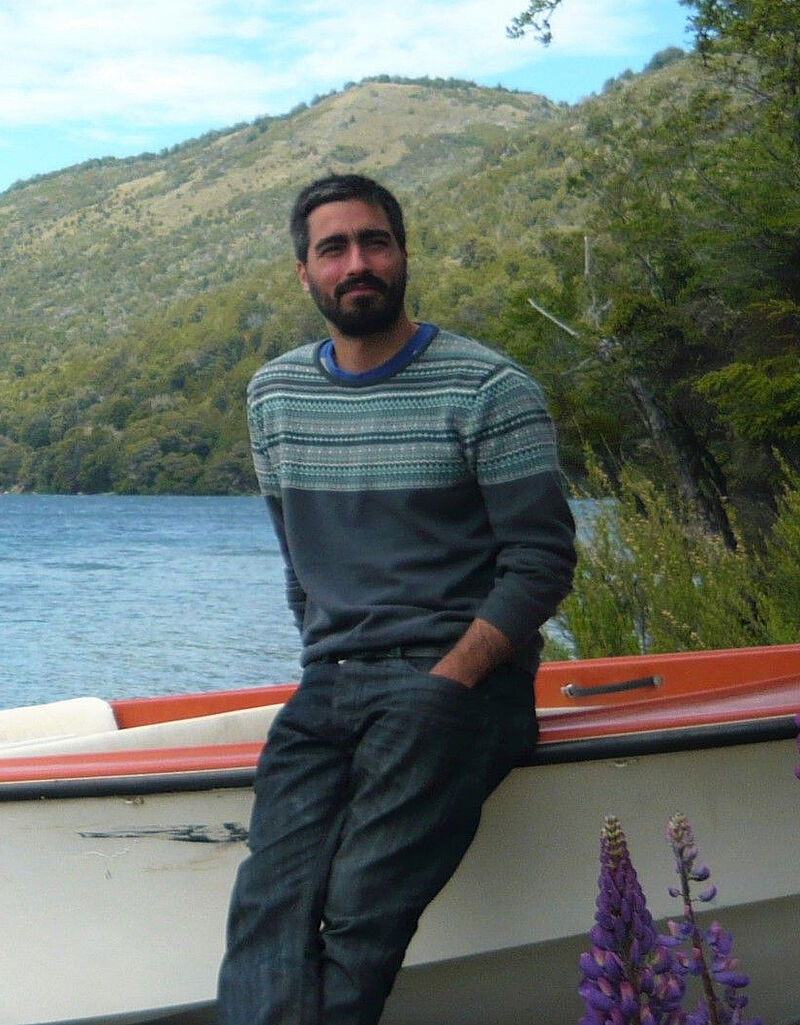
Julián Padró, Dr.
Research Scientist
INIBIOMA (CONICET–National University of Comahue), San Carlos de Bariloche
from March to June 2027
Born in 1982 in Buenos Aires
Dr. of Evolutionary Biology, University of Buenos Aires
Fellowship
College for Life Sciences
Arbeitsvorhaben
GenoMov: Toward a Conceptual Framework Linking Avian Movement, Genomics, and Disease Ecology
The project explores a fundamental but unresolved question: How does animal movement connect evolutionary processes with the spread of infectious diseases?While population genomics reveals how species adapt and diversify, and movement ecology tracks how individuals navigate landscapes in real time, these fields have largely developed independently. As a result, we still lack a unified understanding of how movement, genetic variation, and pathogen dynamics interact.
Using vultures as model systems, I aim to bridge this gap by integrating genomics, high-resolution tracking data, and wildlife disease ecology into a more unified conceptual framework. Vultures are particularly suited for this purpose: as highly mobile and socially structured species, they span migratory and sedentary strategies, enabling direct comparisons across ecological contexts. Moreover, as scavengers, they may act either as regulators of disease or as vectors of pathogens of global relevance.
In this context, genomic data provide insight into immune variation and local adaptation, revealing how populations respond to disease pressures over evolutionary time. Movement data, in turn, capture dispersal routes and ecological connectivity, shaping real-time opportunities for pathogen transmission and exposure. By combining these perspectives with analyses of host-associated microorganisms, the project explores how ecological interactions, behavior, and genetic background jointly determine disease risk.
Ultimately, this research seeks to develop new conceptual routes for integrating disparate data streams to advance a deeper understanding of biodiversity dynamics and global pathogen transmission in a rapidly changing world.
Recommended Reading
Padro, Julián, Félix Hernán Vargas, Sergio A. Lambertucci, et al. (2023). “Demographic Collapse Threatens the Long-Term Persistence of Andean Condors in the Northern Andes.” Biological Conservation 285: 110217. https://doi.org/10.1016/j.biocon.2023.110217.
De Panis, Diego, François Le Dily, Sergio A. Lambertucci, et al. (2025). “Chromosome‐Scale Genome Assembly Provides Insights into Condor Evolution and Conservation.” Molecular Ecology Resources 25 (7): e70000. https://doi.org/10.1111/1755-0998.70000.
Padró, Julián, Sergio A. Lambertucci, Pablo A. E. Alarcón, et al. (2025). “Energy Landscape and Life-History Requirements Shape Habitat Use in an Extreme Soaring Specialist.” Landscape Ecology 40 (7): 136. https://doi.org/10.1007/s10980-025-02137-6.
Publikationen aus der Fellowbibliothek
Padró, Julián (Dordrecht [u.a.], 2025)
Energy landscape and life-history requirements shape habitat use in an extreme soaring specialist
Padró, Julián (Oxford, 2025)
Chromosome-scale genome assembly provides insights into condor evolution and conservation
Padró, Julián (Amsterdam [u.a.], 2023)
Demographic collapse threatens the long-term persistence of Andean condors in the northern Andes