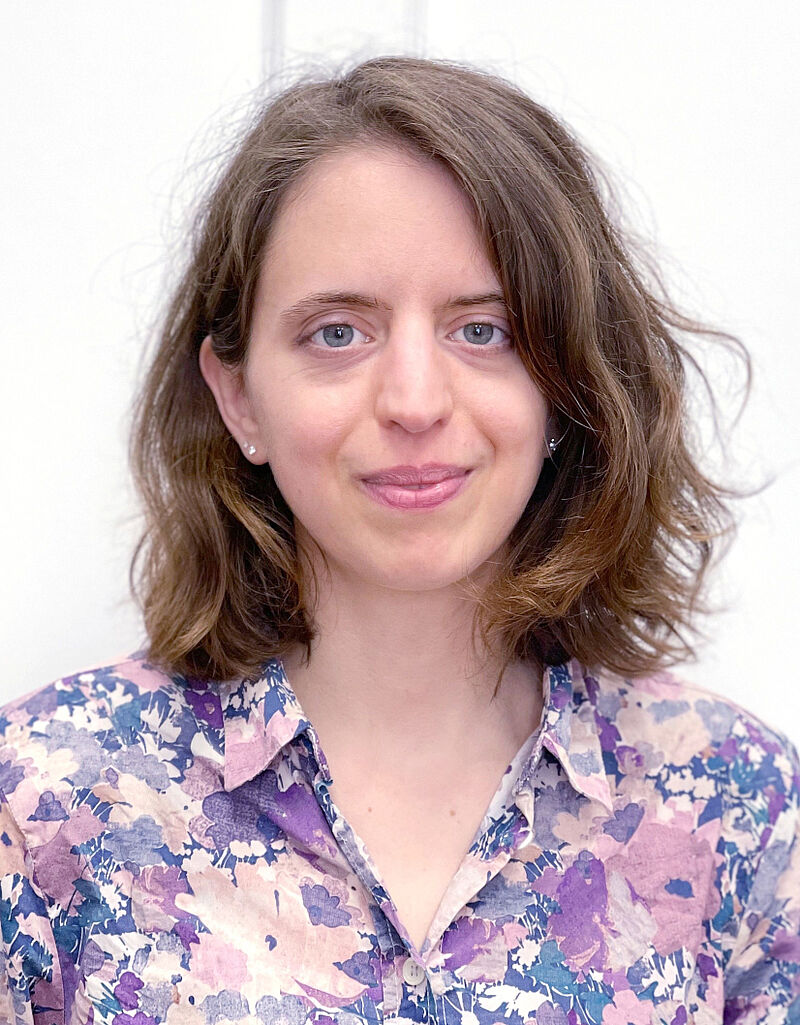
Mirna Elizabeta Kramar, Dr. rer. nat.
Postdoctoral Researcher
Institut Curie, Paris
from September 2026 to January 2027
Born in 1991 in Zabok, Croatia
BSc in Chemistry, University of Zagreb, MSc in Biophysics, TUD Dresden University of Technology, Dr. rer. nat. in Biophysics, University of Göttingen
Fellowship
College for Life Sciences
Arbeitsvorhaben
From Signals to Structure: How Cells Learn to Be a Tissue
Living tissues must achieve something remarkable: They remain stable even though their individual cells are constantly sensing, changing, and responding to their surroundings. How this local variability is turned into lasting collective order remains poorly understood, especially when tissues are perturbed and must recover coherence.This problem is especially pertinent in development, where robustness is not fixed but changes over time. Similar perturbations can be devastating at one stage and recoverable at another, suggesting that tissues differ in how they coordinate, communicate, and retain information as they develop. Understanding these shifts could help clarify more general principles of how living matter stabilizes itself without becoming rigid.
These questions have gained urgency as biology has increasingly turned toward problems of information flow, signal processing, and robustness. We now know a great deal about signaling inside single cells, and we can describe large-scale patterns of multicellular organization, but the connection between these levels is still unclear.
My project addresses this gap by asking how epithelial tissues use shared information to sustain order across time. I am interested in how tissues retain traces of past states and how communication between cells gives rise to collective stability, helping explain how robust organization emerges in living systems. At the Wissenschaftskolleg, I will focus in particular on the mechanisms of tissue memory, the role of intercellular communication in stabilizing collective behavior, and the possibility that robustness in multicellular systems emerges through learning-like processes over time.
Recommended Reading
Kramar, Mirna, and Karen Alim (2021). “Encoding Memory in Tube Diameter Hierarchy of Living Flow Network.” Proceedings of the National Academy of Sciences 118 (10): e2007815118. https://doi.org/10.1073/pnas.2007815118.
Kramar, Mirna, Lauritz Hahn, Aleksandra M. Walczak, Thierry Mora, and Mathieu Coppey (2025). “Single Cells Can Resolve Graded Stimuli.” PRX Life 3 (4): 043016. https://doi.org/10.1103/pyf8-y4kt.
Publikationen aus der Fellowbibliothek
Kramar, Mirna Elizabeta (College Park, MD, 2025)
Single cells can resolve graded stimuli
Kramar, Mirna Elizabeta (Washington, DC, 2021)
Encoding memory in tube diameter hierarchy of living flow network