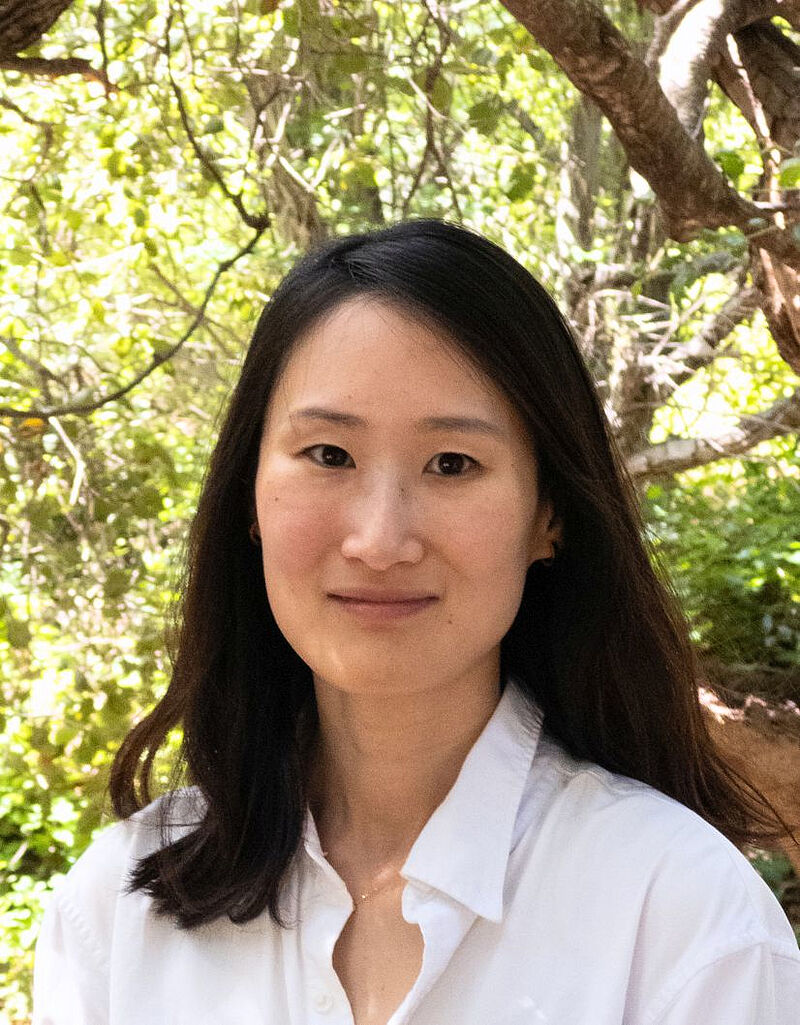
Tae-Yeoun Keum, Ph.D.
Assistant Professor of Political Science
University of California, Santa Barbara
Born in 1986 in Seoul
B.A. in Humanities, Yale University, M.Phil. in Political Thought and Intellectual History, University of Cambridge, Ph.D. in Government, Harvard University
Arbeitsvorhaben
The Symbolic Politics of Blumenberg, Habermas, and Schmitt
My research concerns the symbolic dimensions of politics: To what extent can and should politics be shaped by figurative elements in our thinking—such as symbols, metaphors, and narratives—that are not immediately transparent to reason? During the fellowship year, I hope to explore this question through the lens of a distinctive debate sustained between three giants of twentieth-century German philosophy: Hans Blumenberg, the late Jürgen Habermas, and Carl Schmitt.My project reconstructs the political theory of Hans Blumenberg, who devoted his philosophical career to studying how cultural meaning gets condensed into metaphors, myths, and other figurative forms of discourse that operate through imaginative representations rather than propositional claims. He was defending the dynamic, constructive character of these forms against the influence of Carl Schmitt and his associates, and the sinister reverence they cultivated for the political power of myths and symbols. At the same time, Blumenberg was also challenging the critical account of myth advanced by the Frankfurt School and its intellectual heirs, including its most prominent successor, Jürgen Habermas.
In recovering the surprising ways these three thinkers positioned themselves with and against each other on the questions they shared, I aim to show that the symbolic features of politics are neither trivial nor distractions from substance. I argue that, in the fault lines of their dispute, we can appreciate not only the indispensability of our political symbols, but also our own capacity to rewrite their content. For Blumenberg, Habermas, and Schmitt, symbolic politics stood in deep tension with some of the most defining principles of modernity, including especially a set of ideals at the heart of how we understand rational discourse and its place in politics. Over a three-way debate that unfolded over a century, they staked out sharply different approaches to navigating that tension.
Recommended Reading
Keum, Tae-Yeoun. Plato and the Mythic Tradition in Political Thought. Harvard University Press, 2020.
–. “Plato’s Myth of Er and the Reconfiguration of Nature.” American Political Science Review 114, no. 1 (2020): 54–67. https://doi.org/10.1017/S0003055419000662.
–. “Blumenberg and Habermas on Political Myths.” Political Theory 53, no. 1 (2025): 3–33. https://doi.org/10.1177/009059172412884.
Kolloquium, 13.10.2026
The Politics of Symbols: Myth and Agency in Twentieth-Century German Philosophy
Symbolic politics is on the rise again in contemporary politics, where it presents an especially perplexing problem. On the one hand, the dynamics specific to the politics of symbols often run counter to the norms of rational political processes. On the other hand, these idiosyncratic dynamics are also a ubiquitous – and ever more powerful – feature of politics. Today, shifting political conditions threaten to turbocharge their unpredictable logic.
The premise of my project is that considering the problems raised by symbolic politics has an instructive precedent in a debate sustained between three twentieth-century German philosophers: Carl Schmitt (1888–1985), Hans Blumenberg (1920–1996), and Jürgen Habermas (1929–2026). Despite their radically different political persuasions, the three thinkers shared a lifelong interest in the category of “the symbolic” and its consequences for politics. In this talk, I focus in particular on the disagreement between Blumenberg and Habermas on the concept of myth, which became a uniquely fraught focal point in postwar German discourse on symbols.
Publikationen aus der Fellowbibliothek
Keum, Tae-Yeoun (Thousand Oaks, Calif. [u.a.], 2026)
The politics of Platonism : Voltaire's Socrate and the dynamics of canons
Keum, Tae-Yeoun (Oxford, 2025)
Keum, Tae-Yeoun (Thousand Oaks, Calif. [u.a.], 2024)
Blumenberg and Habermas on political myths
Keum, Tae-Yeoun (Abingdon, Oxon, 2023)
Editors’ introduction : political myth in the twentieth century
Keum, Tae-Yeoun (New York, NY [u.a.], 2020)
Plato’s myth of Er and the reconfiguration of nature
Keum, Tae-Yeoun (Cambridge, Massachusetts, 2020)
Plato and the mythic tradition in political thought