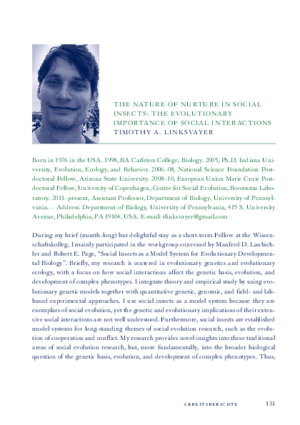
Timothy A. Linksvayer, Ph.D.
Evolutionsbiologie
Universität Kopenhagen
Born in 1976 in the USA
Studied Evolution at Indiana University
Schwerpunkt
Soziale Insekten als Soziale Insekten als Modellsystem für die Evolutionäre EntwicklungsbiologieModellsystem für die Evolutionäre Entwicklungsbiologie
Arbeitsvorhaben
Soziale Interaktionen und die Evolution komplexer Phänotypen
I study how social interactions affect the genetic basis, evolution, and development of complex social phenotypes. My project will focus on how multi-level selection acts on genetic components arising from social interactions to shape social evolution. I will extend a model of physiological epistasis arising from interactions between genes within organisms to intergenomic epistasis arising from social interactions. I will also build upon models of the evolution of sociality that incorporate both genes expressed during development and genes with social effects.Recommended Reading
Linksvayer, T. A., M. K. Fondrk, and R. E. Page. 2009. "Colony-level selection in honey bees produces coevolved socially-interacting gene complexes." American Naturalist 173: E99-E107.
Linksvayer, T. A. 2007. "Ant species size differences are determined by epistasis between brood and worker genomes." PLoS ONE 2: e994.
Linksvayer, T. A. and M. J. Wade. 2005. "The evolutionary origin and maintenance of eusociality in the aculeate Hymenoptera: maternal effects, sib-social effects, and heterochrony." The Quarterly Review of Biology 80: 317-336.
Publikationen aus der Fellowbibliothek
Linksvayer, Timothy A. (Amsterdam, 2022)
Microbiome breeding : conceptual and practical issues
Linksvayer, Timothy A. (Amsterdam [u.a.], 2019)
Linksvayer, Timothy A. (Berlin, 2018)
Pharaoh ant colonies dynamically regulate reproductive allocation based on colony demography
Linksvayer, Timothy A. (2017)
Ant nurse workers exhibit behavioral and transcriptomic specialization on larval stage but not caste
Linksvayer, Timothy A. (Cambridge, Mass., 2017)
The neuropeptide corazonin controls social behavior and caste identity in ants
Linksvayer, Timothy A. (2017)
Linksvayer, Timothy A. (2017)
Genomic signature of kin selection in an ant with obligately sterile workers
Linksvayer, Timothy A. (2016)
Linksvayer, Timothy A. (2016)
Late-instar ant worker larvae play a prominent role in colony-level caste regulation
Linksvayer, Timothy A. (2016)