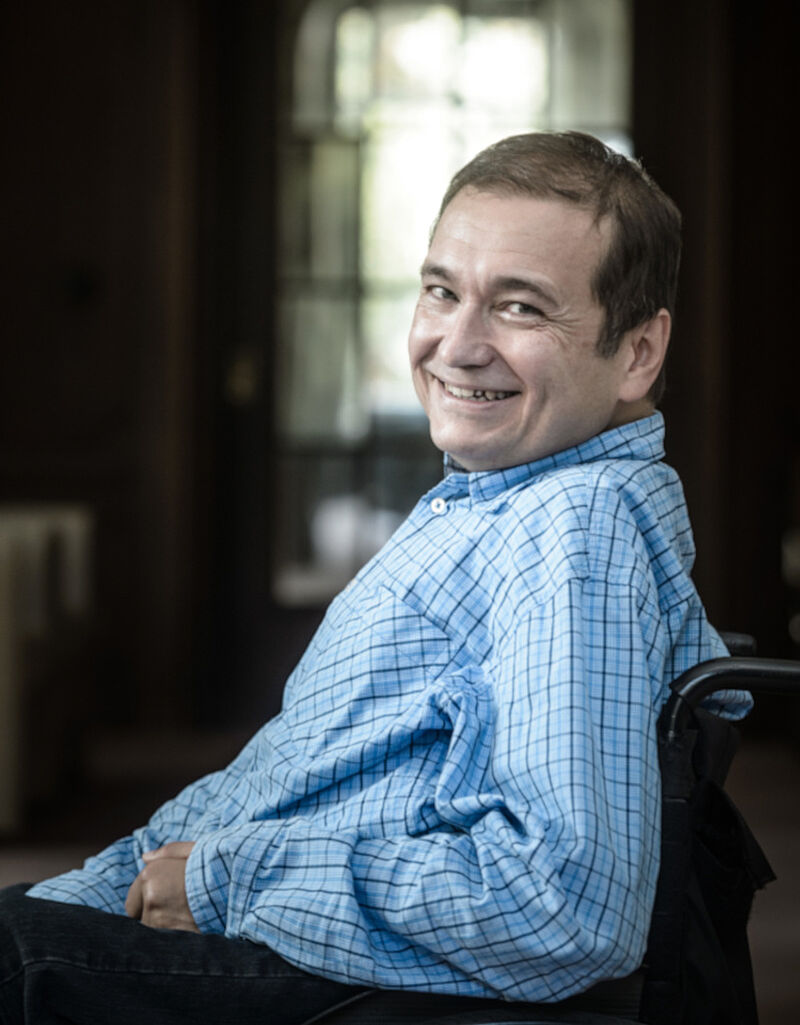
Onur Güntürkün, Dr. phil., Dr. h.c.
Professor für Psychologie
Ruhr-Universität Bochum
Geboren 1958 in Izmir, Türkei
Diplom, Psychologie, und Dr. phil., Psychologie, Ruhr-Universität Bochum
Arbeitsvorhaben
A Wider View of Consciousness
Behavioural and neurophysiological data suggest that some bird species are aware of external stimuli and recognise themselves to varying degrees in the mirror. Despite large differences in the general brain organisation of birds and mammals, the requirements for consciousness as outlined in different theories about the neural fundaments of consciousness are mostly met. Furthermore, studies of self-recognition in birds provide further behavioural evidence of the limitations of current behavioural paradigms like the mark test for evaluating signs of self-awareness. These findings could provide insights into the bigger picture of the evolutionary roots of consciousness. It seems that self-awareness is adapted to the ecological constraints of the species. Moreover, consciousness should not be deemed as an “all-or-nothing” cognitive function, but rather as a graded process. These results add to the growing body of evidence that consciousness may be present in many parts of the animal kingdom, across species that are phylogenetically distant from each other and have remarkably different brain structures. It is certainly too early to speculate whether this is the result of convergent evolution or results from a distant common ancestor. But if so many animals with such diverse brain organisations are conscious, it becomes increasingly likely that consciousness adds cognitive abilities that are evolutionarily successful. I will integrate the comparative literature on animal consciousness and aim to expand it by two new studies from my lab. By this, I aim to achieve a new view of consciousness that is less anthropocentric but explores the option that consciousness, once hailed as the ultimate triumph of human evolution, could constitute in its most basic form a rather mundane cognitive process that allows diverse animal species to simply keep track of what is currently important.Recommended Reading
Güntürkün, Onur (2021). “The Conscious Crow.” Learning & Behavior 49: 3–4. https://doi.org/10.3758/s13420-021-00466-5.
Hillemacher, Sonja, Sebastian Ocklenburg, Onur Güntürkün, and Inga Tiemann (2023). “Roosters Do not Warn the Bird in the Mirror: The Cognitive Ecology of Mirror Self-Recognition.” PLoS ONE 18: e0291416. https://doi.org/10.1371/journal.pone.0291416.
Güntürkün, Onur, Roland Pusch, and Jonas Rose (2024). “Why Birds Are Smart.” Trends in Cognitive Sciences 28 (3): 197–209. https://doi.org/10.1016/j.tics.2023.11.002.
Kolloquium, 25.11.2025
The Parallel Evolution of Complex Cognition
The famous evolutionary biologist Stephen Jay Gould once aptly remarked: “If you could rewind the film of life under the same conditions, evolution would take a completely different course, and the human mind would not re-emerge, even if you could play this film of life a thousand times.” In contrast, his contemporary colleague Simon Conway Morris wrote: “Convergence points to the existence of a deeper structure of biology ... Evolutionary paths are diverse, but the goals are limited.” Decades after this controversy, we are increasingly discovering that evolution indeed seems to have serious limitations in its degrees of freedom. At least when it comes to brain and cognition. Take the following example: great apes such as chimpanzees have complex cognitive abilities and a brain weighing approximately 400 g, which includes a large neocortex. In comparison, birds such as corvids and parrots have a brain weighing between 3 and 25 g and no neocortex. This should make it impossible for birds to develop high cognitive abilities. However, studies over the past two decades have shown that there is not a single cognitive ability in chimpanzees that has not also been demonstrated in corvids and parrots. And not only that, also the mechanisms of thought are absolutely the same. This truly sounds like Simon Conway Morris: “Evolutionary paths are diverse, but the goals are limited.” How is this possible? This question keeps me awake at night because it challenges fundamental assumptions about the evolution of the neural basis of complex cognition. I have come to realize that I must travel back to the depths of vertebrate evolution to find answers. This lecture is about that journey.
Publikationen aus der Fellowbibliothek
Güntürkün, Onur (München, 2020)
Faszination Wissenschaft : 60 Begegnungen mit wegweisenden Forschern unserer Zeit Faszination Wissenschaft - Herlinde Koelbl
Güntürkün, Onur (Palo Alto, Calif., 2016)
The neural basis of long-distance navigation in birds
Güntürkün, Onur (Amsterdam, 2016)
Güntürkün, Onur (London, 2015)
Whistled Turkish alters language asymmetries
Güntürkün, Onur (New York [u.a.], 2015)
Network structure of functional hippocampal lateralization in birds
Güntürkün, Onur (Hamburg, 2015)
Unser Gehirn : wie wir denken, lernen und fühlen
Güntürkün, Onur (2014)
Geist - Gehirn - Genom - Gesellschaft : wie wurde ich zu der Person, die ich bin?
Güntürkün, Onur (Stuttgart, 2014)
Geist - Gehirn - Genom - Gesellschaft : wie wurde ich zu der Person, die ich bin? ; Vorträge anlässlich der Jahresversammlung vom 20. bis 22. September 2013 in Halle (Saale) Nova acta Leopoldina ; Neue Folge, Nummer 405 = Band 120
Güntürkün, Onur (2012)
The convergent evolution of neural substrates for cognition