
Issue 21 / July 2026
“You have to look past that”
Stephan Schlak and Daniel Schönpflug
The Rector in Her Time – Barbara Stollberg-Rilinger on Tests of Courage, Helpful Rituals and Risky Decisions
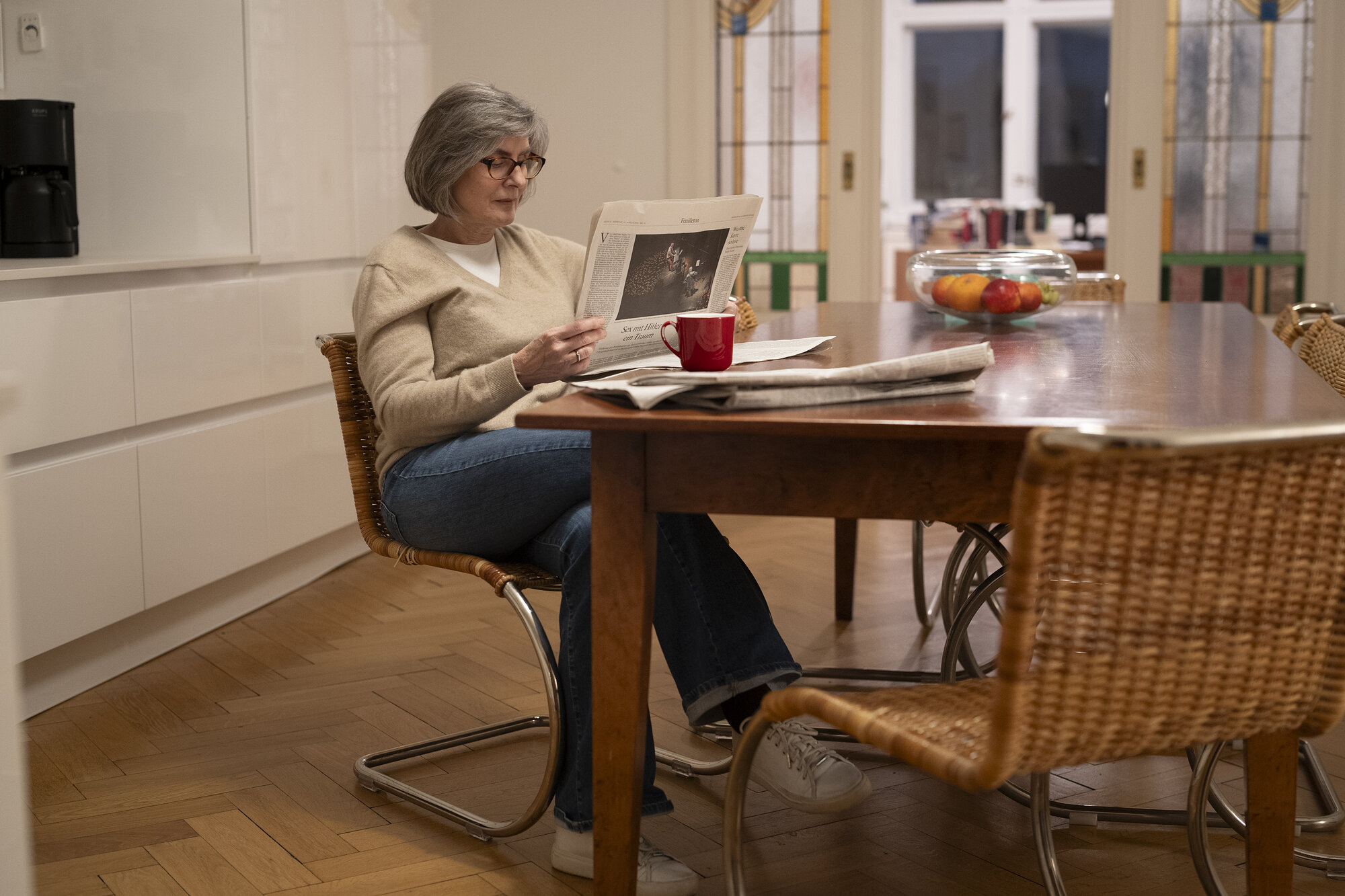
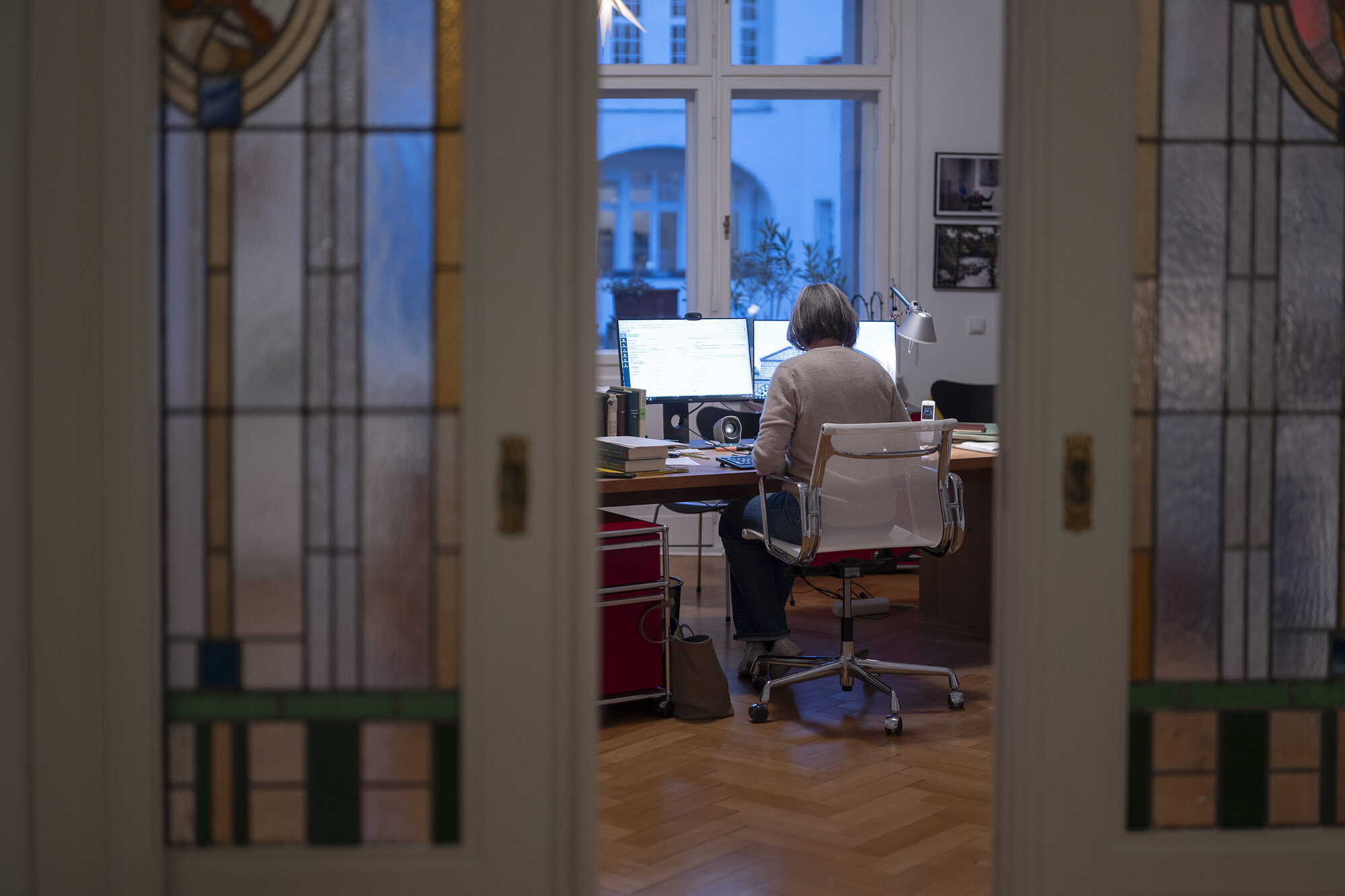
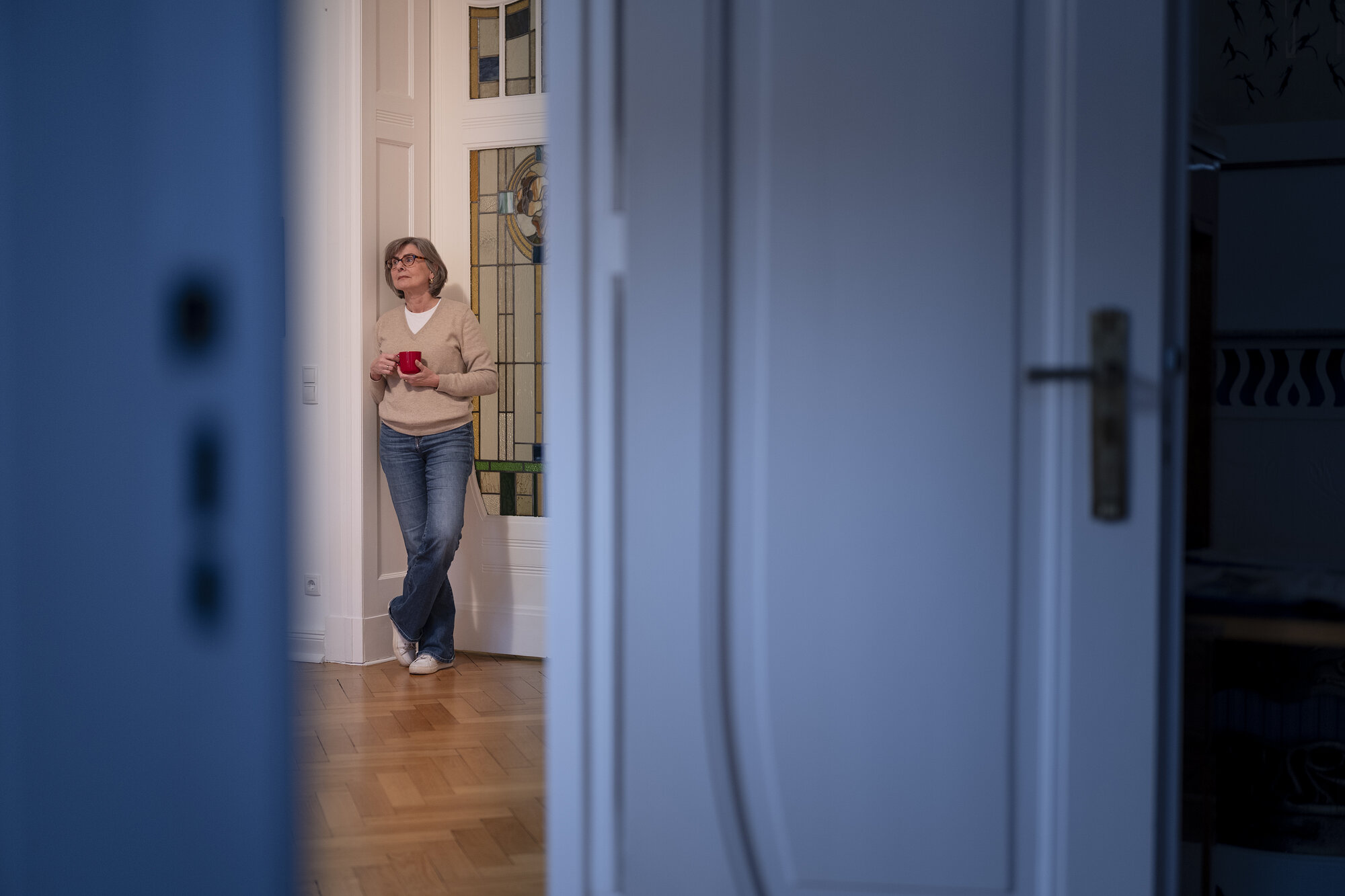
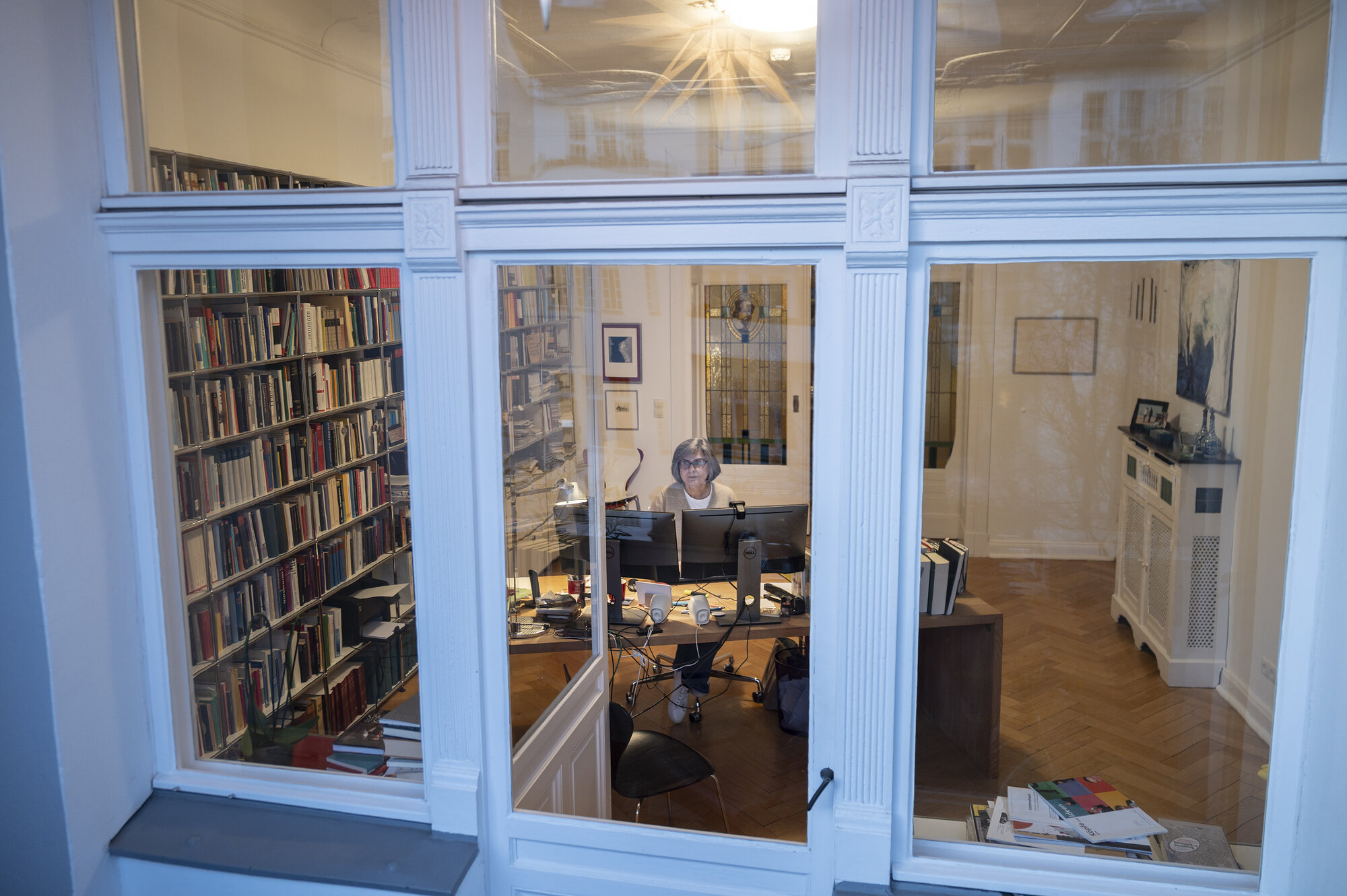
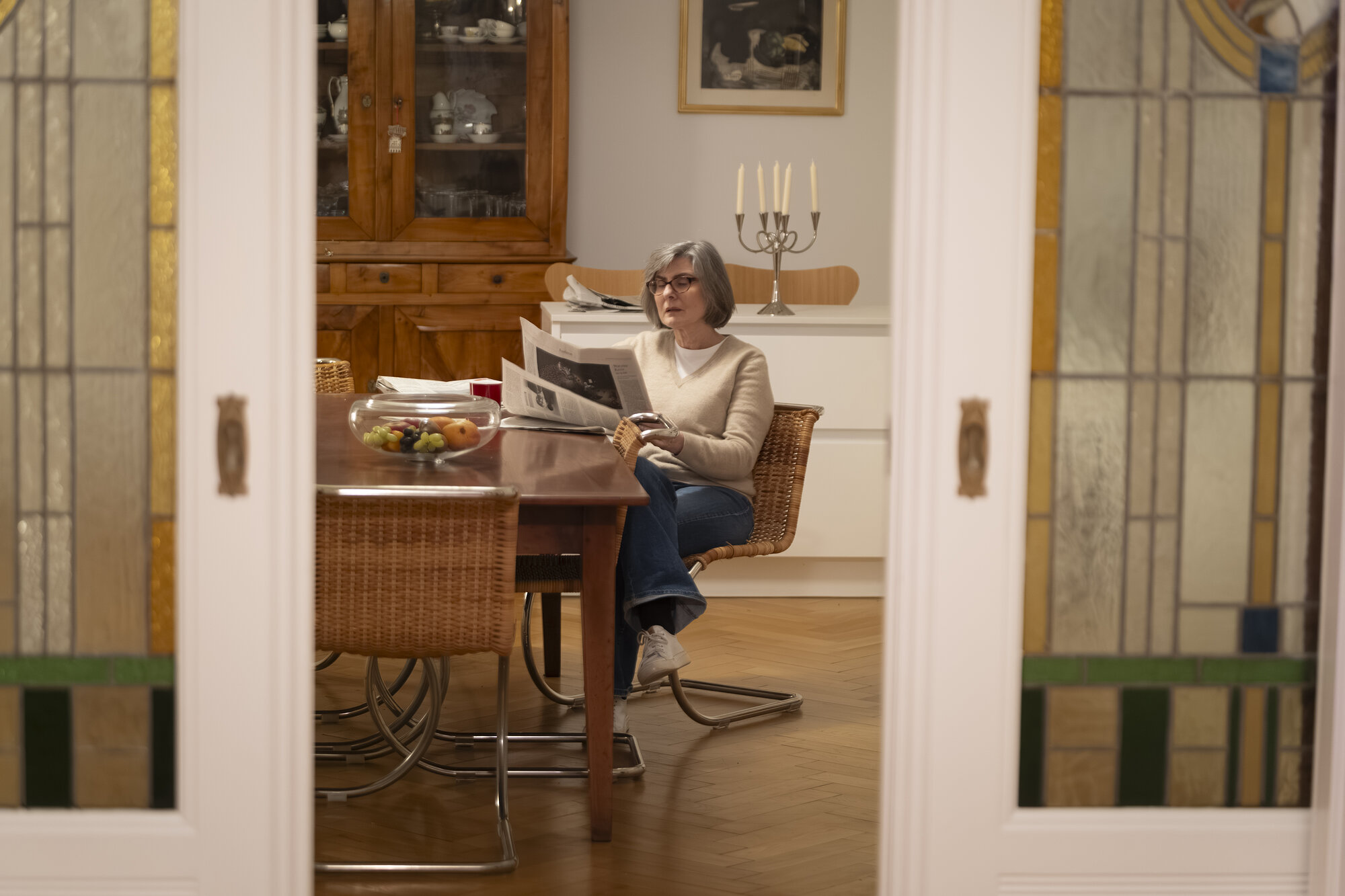
From a stairwell adorned with art nouveau ornamentation, the apartment door opens into a painstakingly renovated prewar home. Dividing the living-room from the dining-room is a sliding door with colorful stained-glass detailing. The study, with a view of the treetops lining the street, feels as if not just every book but every thought has its proper place. It’s a space that exudes a passion for intellectual labor. In just a few months Barbara Stollberg-Rilinger’s tenure as Rector of the Wissenschaftskolleg zu Berlin will have ended; but in seeing the stacks of books, one senses that she’ll have no problem keeping boredom at bay.
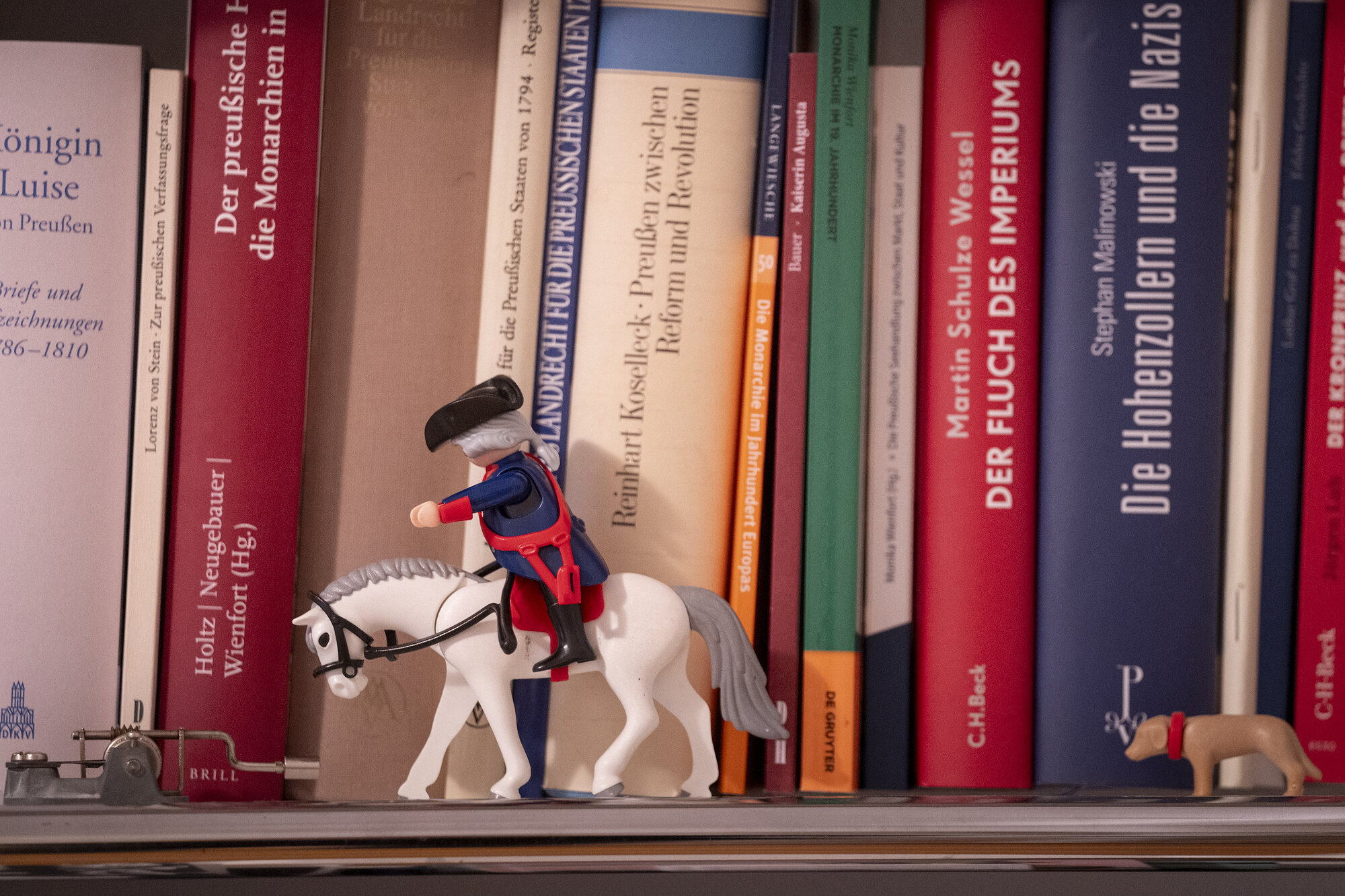
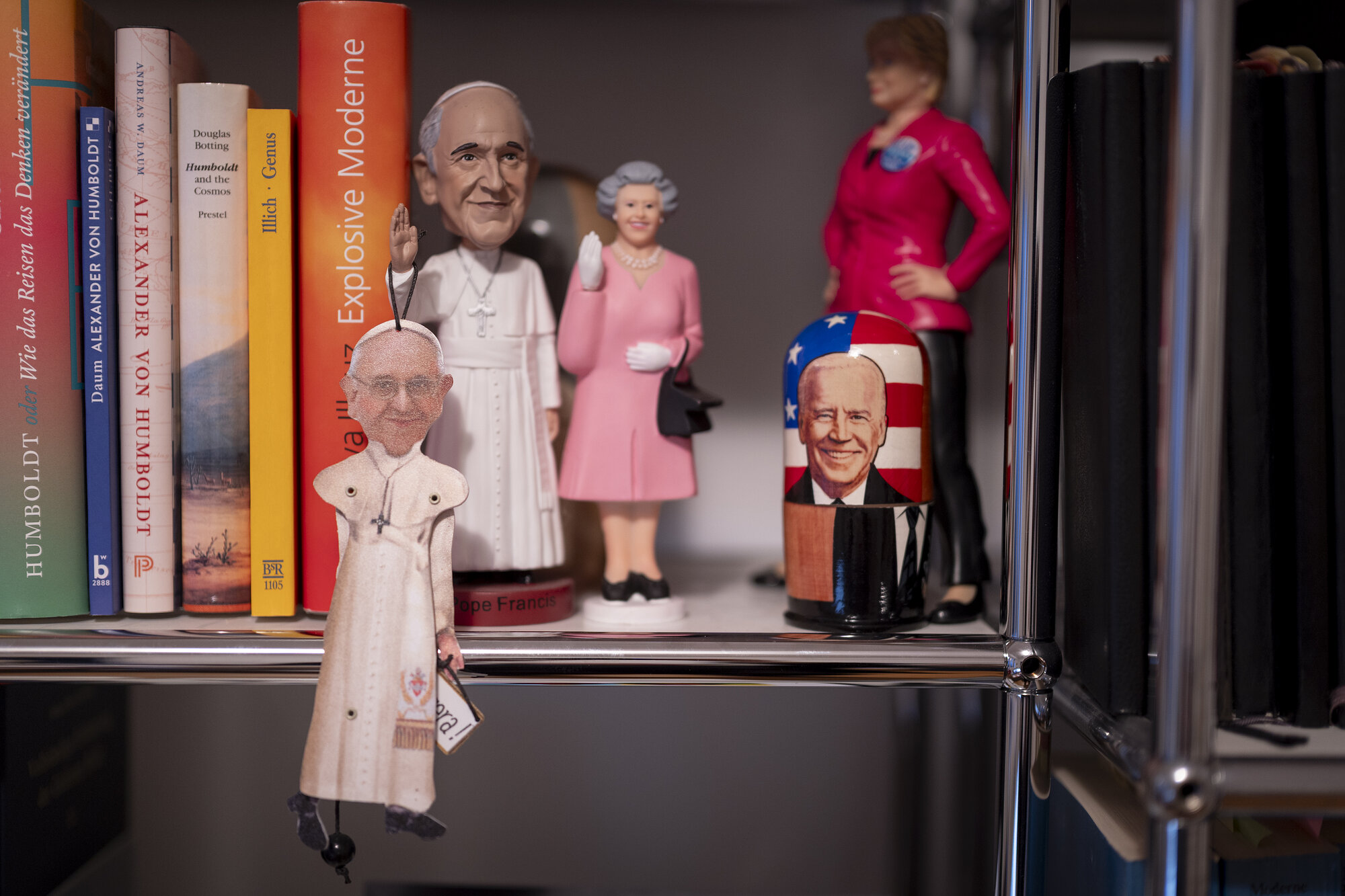
On a shelf some plastic figurines catch the eye. Among them is a Playmobil figure of Frederick the Great on horseback. But Her Majesty Queen Elizabeth II is also there in plastic waving her hand. Next to her stand Angela Merkel and the American president who, in his Prussian guise, will shortly enter the conversation.
Stephan Schlak & Daniel Schönpflug: You have a penchant for the great figures of history, wouldn’t you say?
Barbara Stollberg-Rilinger: I’m actually less interested in great figures than in the structures that enable them. So I’m fascinated by the courtly world of the early modern period, or by a symbolic order like the Holy Roman Empire. They generate prominent personalities, but they also constrain them.
StS & DS: It wasn’t easy to constrain Prussia’s King Frederick William I, whom you are currently researching. He simply eschewed rituals and conventions, inventing his own, which were often extremely brutal. From a contemporary perspective this seems vaguely familiar.
BStR: With Frederick William I, I’m dealing with a monarch who was a classic autocrat. And as I write his biography, we are experiencing the rise of autocracy in America, in fast motion. There are many similar patterns. Just as Trump surrounds himself with his wrestling stars, Friedrich Wilhelm had Eggenberg who could bend a horseshoe. Both act erratically. Both surround themselves with flatterers. Both enjoy rituals by which they can humiliate others. Nonetheless, I must be very careful not to overburden the world of the eighteenth-century with contemporary relevance. Friedrich Wilhelm didn’t need to be elected, nor was he a populist, nor did he concern himself with the people. And the media landscape today is completely different. Nonetheless, in such a constellation a tension arises between that sense of foreignness – which for me is the very essence of historical insight – and those certain parallels that practically impose themselves.
StS & DS: Whence this interest of yours in rituals? Can it be traced back to your days in Cologne?
BStR: I grew up in a very Catholic city, Cologne. Every Sunday my sister and I had to attend mass. At the time, we found it odd that my father and mother usually didn’t come along. My mother prepared lunch. My father went to the bar across the street from the church. At a certain point it dawned on me that this didn’t make much sense. I was quite captivated by the liturgy but also felt guilty about not keeping pious for duration of the mass. Later as a university student, I experienced it as a kind of revelation that there is such a thing as ritual theory. In retrospect that’s how I came to understand what a sacrament is – a ritual that begets what it depicts. This notion helped me to regard the religious experience of my childhood from the outside. I do believe that I look at rituals in a different way than someone who was socialized as a Protestant.
StS & DS: These experiences certainly helped you when you joined the Wissenschaftskolleg as a Fellow in 2015/2016. That’s an environment which is also shaped by ritualistic forms. Did you sometimes feel as if you had been bodily transported into your own field of research?
BStR: Of course I noted the recurring rituals, the common lunches and the Colloquia which give Wiko its certain atmosphere and flair. But then there is the fantastic staff, the administrative machinery that keeps everything running. That’s what makes the Wissenschaftskolleg so special. A modern organizational structure supporting a sense of community that in many respects is comparable to an old-style republic of letters. That which is becoming increasingly exotic in the digital world is lived practice here. The Wissenschaftskolleg thrives on the impact of personal presence. Here too there would seem to be connections to the presence-based society of the early modern period.
StS & DS: You’re thinking of Rudolf Schlögl’s work on social formation in face-to-face presence . . .
BStR: Yes! My colleague Schlögl calls them “communities of presence,” where the social structure depends on repeated face-to-face encounters rather than on general abstract written bylaws. That’s also how it is at Wiko. But here the common presence ends after ten months. Then a new group arrives and everything starts all over again. Just how crucial this is became quite clear during the Covid pandemic.
StS & DS: The disadvantages of a presence-based culture have of course been studied for the early modern period – the fear of losing face, the “pressure to maintain harmony.” Does this also apply to the Wissenschaftskolleg?
BStR: Absolutely. But everyone deals with this behavioral framework in different ways. There’s the type of Fellow who is very reserved and only opens up in small groups; then there’s the one who cracks jokes; then the one who fosters social cohesion, is good friends with everyone, consoles people and is the best source for juicy gossip. Of course there’s also egotistical behavior from Fellows who like to ask long-winded elaborate questions right before the end of a Colloquium, even though ten people are still on the list of speakers. All these roles are filled anew every year.
StS & DS: You once compared your assumption of the rectorship in 2018 to a dive from the 3-meter springboard in the Cologne outdoor swimming pool.
BStR: I’m actually a fairly reserved person. Even as a child I felt uneasy around large groups of kids. I tended to give them a wide berth. But in the course of my life I have learned that you are sometimes faced with tests of courage. Assumption of the rectorship was certainly one of those tests where I thought: just give it a try. Fortunately the role of Rector is one that you can learn. Plus, from the very beginning, I had a staff of very reliable people around me.
StS & DS: How can a professor of early modern history prepare to lead the Wissenschaftskolleg? Did you reread all the “mirror for princes” literature?
BStR: I read Niklas Luhmann. In his book The New Boss he describes quite well the paradox of the new boss at top of the hierarchy who still has no real idea of how the place functions. And he or she has to somehow cope with this paradoxical situation. That’s how it was with me. Of course in the beginning this creates all kinds of problems. As an early modern historian, the practice of dissimulatio helps you avoid making it too obvious to others that you don’t yet know much about the formal procedures and well-established routines of the institution.
StS & DS: In institutions based on rituals among those present, it is difficult to initiate change.
BStR: It works if you have patience. Under the first Rector Peter Wapnewski, as people have told me, the ceremony was completely different. At lunchtime there was a long table presided over by the Rector who would call on individuals to speak. Wiko back then might be compared to the court of Frederick I, where a strictly hierarchic and solemn Baroque style held sway. He was, after all, the first King in Prussia. He had to establish a royal court more or less from scratch. I see today’s Wissenschaftskolleg rather like the salon of his wife Sophie Charlotte. In their residence at Lützenberg, today’s Charlottenburg, things were rather informal – yet not disorderly. There is a lovely source that lists what one should not do there. This gave rise to a sociability that was subject to certain rules, but which were followed implicitly, effortlessly and without coercion. That would be my ideal.
StS & DS: You come from Cologne, have lived in Bielefeld and Münster, but now see yourself as a Prussian queen?
BStR: Certainly not! From a Cologne perspective, Berlin is something we make fun of during Carnival.
StS & DS: Has the Wissenschaftskolleg become more egalitarian?
BStR: I think so. We can learn from history that egalitarian conditions do not arise naturally. If you want them you have to create them. You must establish a framework where differences of gender and origin – but also rank and hierarchy in the outside world – are explicitly set aside. This can be learned from Koselleck’s Critique and Crisis. In my view Wiko must be just such a framework. And if the Fellows establish their own pecking orders among themselves, then that’s their problem and I won’t get involved.
StS & DS: But the Rector still has the last word?
BStR: According to the bylaws this is stipulated – which is why there are no formal votes in the Wiko selection committees. But firstly the Wissenschaftskolleg is of course a large apparatus, a well-oiled mechanism that normally requires no intervention. Secondly, I would naturally be ill-advised to act against the unanimous counsel of the Permanent Fellows or the Academic Advisory Board or my competent colleagues in the administration.
StS & DS: An earlier research project of yours was entitled “Cultures of Decision-Making.” You yourself are considered quite decisive.
BStR: In this Münster research consortium, we spent a great deal of time thinking about non-decision-making – which is itself a decision. At the moment of decision it is never certain whether your decision is correct. The future is always open. That’s why every decision is risky and in hindsight open to challenge. If you wish to avoid conflict, then the tendency is not to decide at all and just hand the issue over to a commission that then talks it to death. This would be neither practical nor desirable for an institution like ours. Important to me, for instance, was to ensure a fairly balanced gender ratio among the Fellows.
StS & DS: A Festschrift dedicated to you was entitled “Nettigkeit und Eigensinn,” in English “Kindness and Obstinacy.”
BStR: Yes. That was a clandestine text of which only two copies exist. But yes, I give people the benefit of the doubt. And I’m seldom disappointed. With just a few exceptions.
StS & DS: Some decisions are dictated by reality. You were the Rector during a time of crisis.
BStR: We’ve already touched upon the difficult years of the pandemic. But even more unnerving were the two civilizational ruptures – firstly Russia’s invasion of Ukraine in 2022 and later the massacre of 7 October and what followed. We experienced the Russian war in an immediate way here in Berlin, at times having 2000 refugees arrive in a single day. On short notice we took in Ukrainian scholars, housing them at Wiko and in private accommodations. We also took in Russian dissidents who had left their homeland for political reasons. In the beginning, in the restaurant they were obviously trying to avoid sitting at the same table with each other. But after only a short time their reservations dwindled and you could see the two groups in conversation. They were united in their rejection of Putin, and they shared a language. As is so often the case, things on a small scale turn out differently from how one reads about them in the newspaper. What began as a spontaneous engagement in 2022 has since become a project – the Virtual Ukraine Institute for Advanced Study. Thanks to the Volkswagen Foundation’s funding, we can support some thirty Ukrainian scholars every year.
StS & DS: A year later the war in Gaza began . . .
BStR: . . . along with those shock waves that swept across the international scholarly landscape. When you examine pre-modern contexts, certain patterns become recognizable. We don’t live in the sixteenth or seventeenth century, but we’re seeing the return of a certain social dynamic that today is called polarization. It’s becoming increasingly difficult to assume mediating middle-ground positions. The space in the middle is shrinking and eventually there will be no shared basis of understanding at all. In some respects it reminds me of the age of confessionalization, when the issues at stake were entirely different, but one can observe a similar social dynamic. You might call it a culture war. Those who try to maintain a calm and factual stance find themselves exposed to massive hostility and suspicions from both poles. The potential for scandalization is growing. The sociologist Steffen Mau speaks of trigger points that set off and further intensify such dynamics. Even the Wissenschaftskolleg has not been entirely spared from such tendencies on occasion.
StS & DS: Those kind of tensions are tough to navigate. Was that – to completely shift gears here for a moment at the end – one reason why you declared a cheerful state of emergency and insisted on introducing an annual Carnival celebration?
BStR: That has certainly provoked mixed reactions and some disconcertment here in Prussia. But you have to look past that. Fortunately, the Secretary General is also from the Rhineland and very fond of Carnival.
StS & DS: In Cologne there is of course the Peasant, the Prince and the Virgin. What were you dressed as?
BStR: Always as someone else, in keeping with the particular theme: Mack the Knife, Mister Spock and Marge Simpson, to whom I can really relate. Now try and guess the themes!
StS & DS: What happens in Carnival stays in Carnival. During Stollberg-Rilinger’s tenure at the Wissenschaftskolleg, what must we not talk about?
BStR: On that question I exercise my right to remain silent.
More on: Barbara Stollberg-Rilinger
Images: © Maurice Weiss