







Issue 21 / March 2026
On the Limits of Power by Administration
by Gerald Wagner
Brian Larkin, an anthropologist from Columbia University, is interested in the British Empire’s internal communication – a wide-ranging subject and not just from a geographical standpoint
As to the picures: On many mornings (and on the occasional evening, too) Brian Larkin opens his laptop at “Café Klick” on Stuttgarter Platz in Charlottenburg - just a short bike ride from the Wissenschaftskolleg.
Africa in the year 1800 was comprised of several thousand political entities. As late as 1879, 90 percent of the continent was still ruled by Africans, but by 1912 this proportion had shrunk to a tiny remnant. The European colonial powers had divided up Africa among themselves and incorporated it into their empires. This according to the history books. But what is an empire? In his global survey of the “long nineteenth century,” historian Jürgen Osterhammel notes that the ability to suppress rebellion was the sine qua non of any imperial presence. But once that territory was occupied by military force it had to be administered. How did that administration take place?
Answer: By means of long-range information transfer – that is to say, wayfaring objects such as letters, dispatches, reports, documents transmitted by foot, horse, ship and then telegraph. From the center to the margins and back again – read, corrected, commentated. Information was the infrastructure that allowed empire to expand and be consolidated. As it did the form of power shifted as military force receded into the background (though always there as a threat and final resource) and imperial power took place through administration. Colonial Governors, who initially were military men trained in the arts of conquest, were replaced by Oxford and Cambridge trained administrators. This shift, the rise of empire as an information system is the topic of Brian Larkin’s research project this year at the Wissenschaftskolleg.
For more than two decades Brian Larkin has conducted anthropological and historical research in Nigeria, a former performed colony independent in 1960. His research brings together anthropology, African studies, and media theory, particularly the tradition of “archaeology of media” pioneered in Germany which analyzes how the material technologies of media organize human life. He brings this media theory together with research by postcolonial scholars on the specifics of empire. The nineteenth century, the period in which the British Empire came to hold mastery over almost a third of Africa, was also the century that saw the maturation of industrial capitalism and the emergence of the modern corporation. Scholars have referred to this as the control revolution pioneering new technical systems for managing the logistics, supply chains, increased division of labour and managerial revolution that has come to organize modern life. How did these two systems interact? How did these new technical systems of information management come to organize empire and vice versa?
As an Englishman of Irish descent and whose grandfather fought in a war against British rule he is aware this imperialist history is part of Britain’s legacy. It is indeed a certain Miss Heritage who is the employee pictured in the official catalogue of the Colonial Office. Brian Larkin laughs as we gaze at the photo.
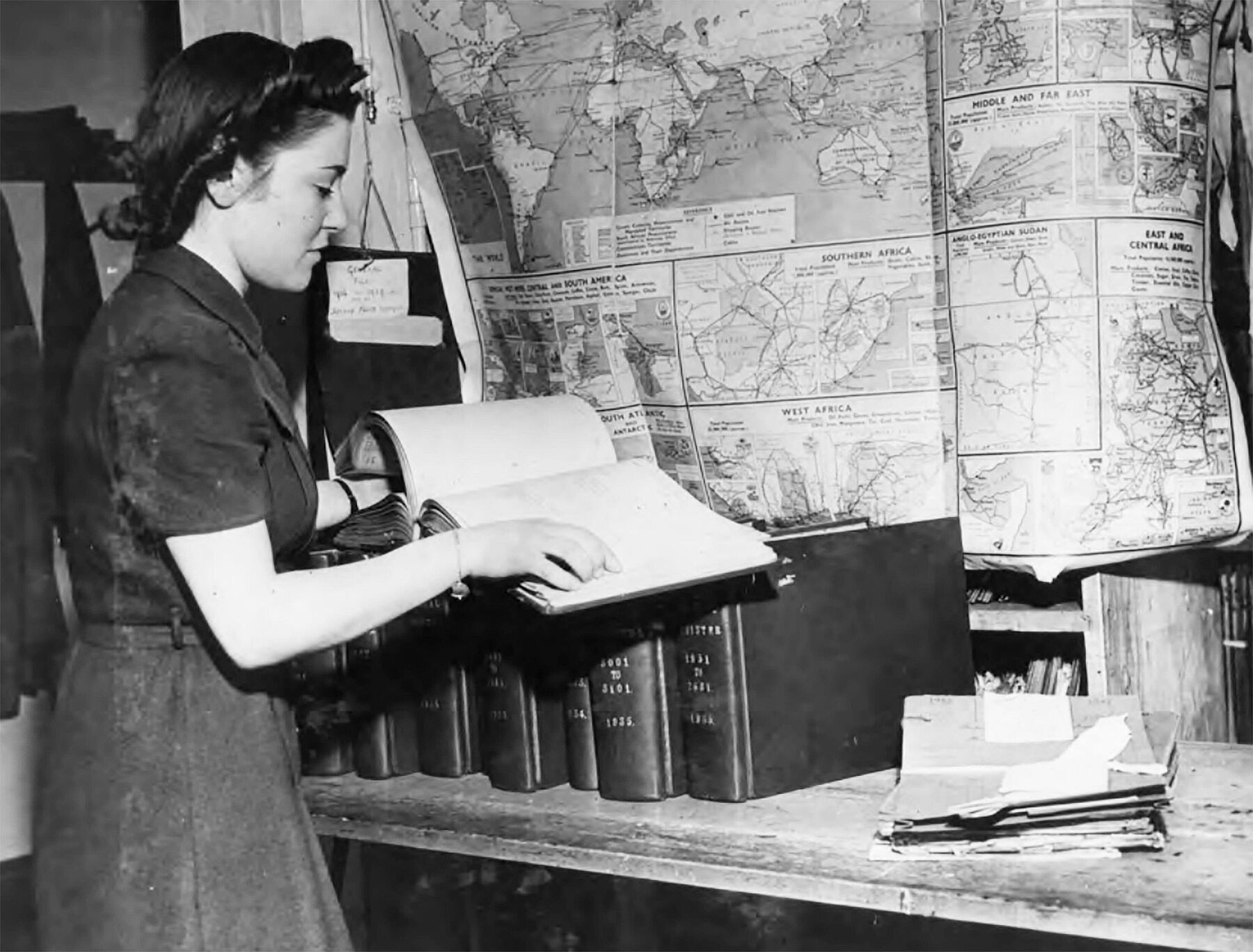
Miss Heritage’s own focused gaze falls on the pages of a thick tome, a whole row of them lined up on her desk, and the caption reads: “The General Registry of the Colonial Office, 1942.” The registry doesn’t look like the center of an empire’s information system; it appears rather untidy with all the crumpled slips of paper and a wrinkled map of the empire spread out over the rickety table. More like a junk room. Not very orderly. One gets the impression that this fragile order could collapse at any moment. And yet in this image Brian Larkin sees the infrastructure of the British Empire. He calls his project “The Media System of Empire” and he wants to “investigate the infrastructure, protocols, forms and archives that comprised the information system of the British Empire.” This image of disorder poses a problem at the heart of his research. In what way does the operation of empire depend on the creation of a technical system for information transfer that facilitated and organized colonial control? And, if this is so, how does that system operate in actual practice within and across colonial territories? If that information system is untidy, with crumpled slips of paper and missing files, how do we factor in the incompetence of information management into our theory of rule?
The question of power and knowledge, and how that was used to organize British administration, has been central to the work of postcolonial history which Larkin draws upon. The history of Larkin’s own discipline, anthropology, is central to this as it was through ethnographic reports, cultural classifications, histories of peoples that Empire was “known” and administred. What Larkin focusses on is the operation of files, their formatting over time, how they were circulated and stored, arguing that these technologies became the means that empire exercised media control over its territories with. It was the information system through which this control was politically enforced. The system did not operate neutrally but actively shaped the empire, and the central focus of Larkin’s research is the form which this shaping took.
Drawing on the insights from German media theory Larkin wants to move away from grand analyses of empire-building like “Great Britain ruled India from 1858 to 1947” to focus on the practical work that “ruling” actually entails and the minor information technologies that organize that rule. How does a single country rule over entire continents with completely different cultures, religions and ethnicities that are tens of thousands of kilometers away?
Well, by trying to impose standards that operate as if these differences don’t exist. This can mean requiring bureaucracy in the English language, that education, bureaucratic order, forms, even modes of address be formatted to commensurate information across difference. Documents are the means for this bureaucratic formatting. Examining them, as historians and media theorists have taught us, means looking beyond the information a document contains. It requires looking at the document itself and how it standardizes and organizes human actions.
Example: On 10 October 1923 the Colonial Office, Miss Heritage’s employer ascertained that throughout the empire there were at least six different spellings of the word “Mohammed” (such as Mahomed, Muhammad, Mohamed) and said a standard version should be selected. But when they discussed which was the correct spelling they could not agree. An in-house survey only added to the confusion. For some, “Mohammed,” which had been the standard spelling for a century was correct. For others, “Muhammad” was the more correct transliteration. Who would resolve the dispute? British scholars of Islam in London? Islamic scholars? Colonial officials? The Foreign Office? To resolve this, the Colonial Office sent dispatches to local authorities in Iraq, Palestine, India, Ceylon, Malaysia, Nigeria and Kenya and a host of other territories to come to a single, standard version to be everywhere applicable. That is our classic idea of colonial power, says Larkin, the massing of knowledge about imperial territories to place that knowledge at the service of the enforcement of norms established by the center.
Larkin’s research “follows the file” as it fanned out across empire. His search begins in the Colonial Office archives, which are located in London, just like those of the India Office. Fortunately, empires never throw anything away, you just have to track the stuff down. So Larkin traveled to southern and northern Nigeria, then on to Sri Lanka, hot on the trail of those circulating objects of the inquisitive empire. And what was the end result? A single standardized name, laughs Larkin, but the wrong one!
What does this story really tell us? For Brian Larkin it is a story of both power and incompetence. It was the attempt to impose a standard controlled by British rule and also how that standard failed. How the British were also questioned by Muslim clerics of these countries; by Muslim members of the local parliament in Sri Lanka. Larkin describes this practice as a collecting and comparing of information about those subjected to the empire. Postcolonial scholars have concluded from this that even empires cannot rule without recognizing the knowledge of those they rule – and the ruled, in turn, use this recognition as a means of ultimately emancipating themselves from the empire’s claims to power.
This emancipatory approach is naturally to be found in Larkin’s work as well. He argues that an empire always has an engine room of standardization, but every empire which is in the process of expanding must eventually realize that it also requires a vast apparatus of translation. Everything – administrative practices, technologies, languages – must be adapted and translated, and there must be an acknowledgement of diversity. Anthropology has always sought to ascertain the immeasurable variety of human practices devoted to making sense of the world. In the course of this project, Brian Larkin has not morphed into an historian or a political scientist but has remained an anthropologist, and he delineates this emancipatory element at the core of the British Empire’s information system with the concept of its “creolization.” This linguistic term describes the fusion of different cultures, especially the formation of new dialects. This may sound like a process of adaptation – the transformation of something homogeneous and normative into an amalgam, a practical form of everyday usage – but that is not what Larkin means. For him there are really only these creolized forms, be they cultures, languages or empires.
What would Miss Heritage in her London office in 1942 have said about all this? She was certainly aware that in her global empire thousands of languages were spoken, yet the correspondence that she archived was naturally composed in English. Just five years after this photo was taken, the loss of India marked the beginning of the end of that empire. The magnificent information system with which the British had overlaid their global realm was appropriated by the colonized peoples to liberate themselves from this claim to rule – even if it consisted “only” of information channels, telegraph lines or post offices on the periphery of their dominion. But these systems have long afterlives and continue to organize the lives of Indians, Malaysians, Nigerians and others through postcolonial bureaucracies. All the material traces of this empire followed by Brian Larkin on their long trips testify to the futility of trying to control the world. In this regard he draws on Michel Serres’s theory of the parasite, according to which there were other beneficiaries who crept into the system, deviations were amplified, weaknesses exploited and turned against that central power which remained unsuspecting. The fundamental figure of the parasite within the system’s media infrastructure is that of appropriating the system for one’s own needs – its transformation, its translation into one’s own language, whereby the demands of the ruled can be articulated with one voice.
That’s why, says Larkin, his work has a dual focus: the building of information systems and their relationship to the exercise of power, but also the collapse of these systems and what this reveals about the limits of imperial power. He wants to know in what ways the specific information systems of empires are constitutive of the character of these empires. Larkin calls this distinctive achievement of information systems the “media synchronization of imperial territory.” So is the basic condition of an imperial presence the ability to synchronize diversity? This is no objection to Jürgen Osterhammel’s definition of imperial presence as manifesting itself in the ability to suppress uprisings, but is rather an indispensable supplement to that framing. Throughout the long nineteenth century it was ultimately the empire – and not yet the nation-state – that was the dominant territorial form of political power on a global scale. To understand this phenomenon would mean to understand the century.
More on: Brian Larkin
Images: © Maurice Weiss