
Issue 21 / March 2026
Rubbish and Resource – Waste in 18th-Century London
by Manuela Lenzen
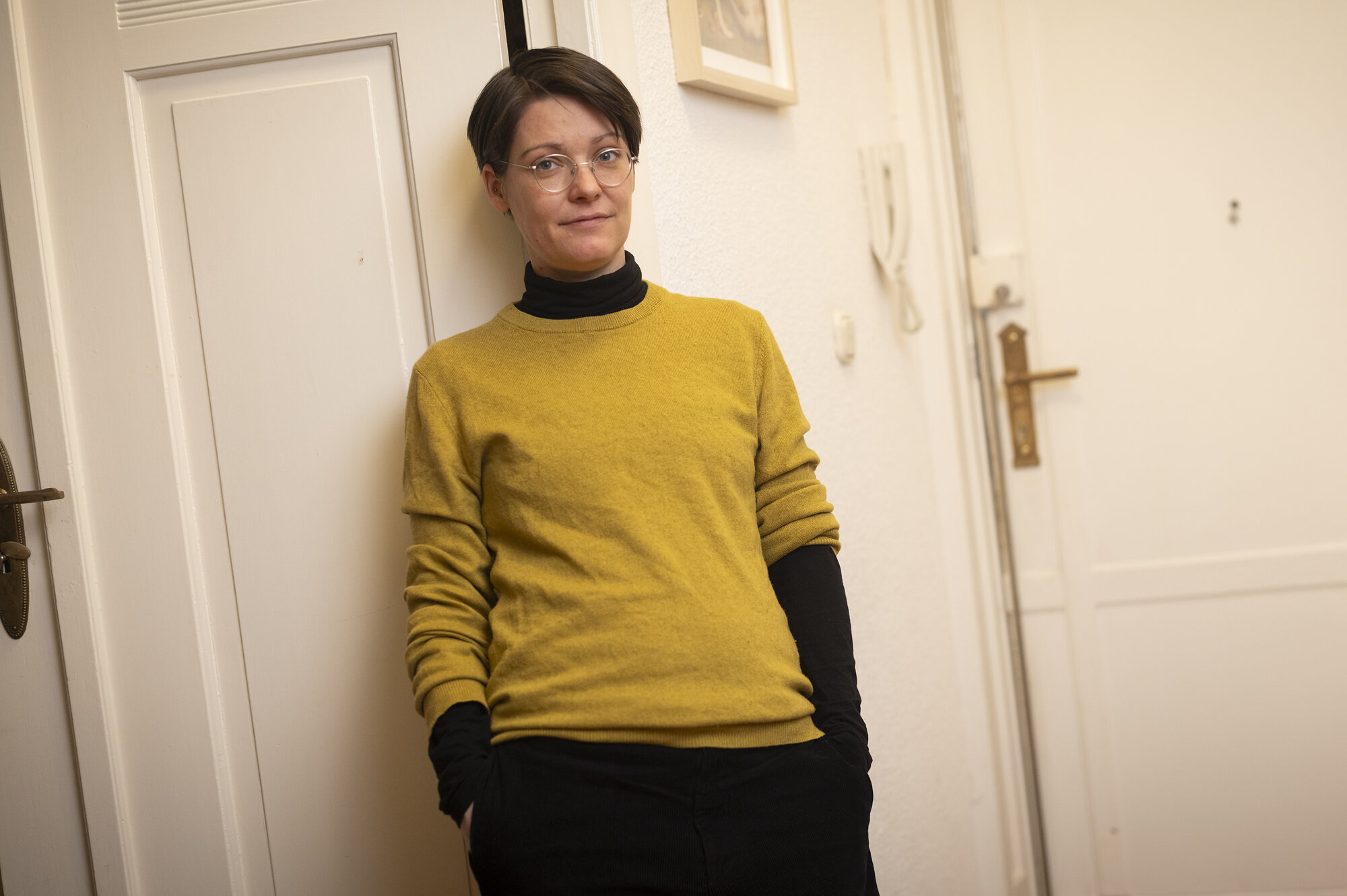
The historian Franziska Neumann is interested in how early-modern London handled its waste
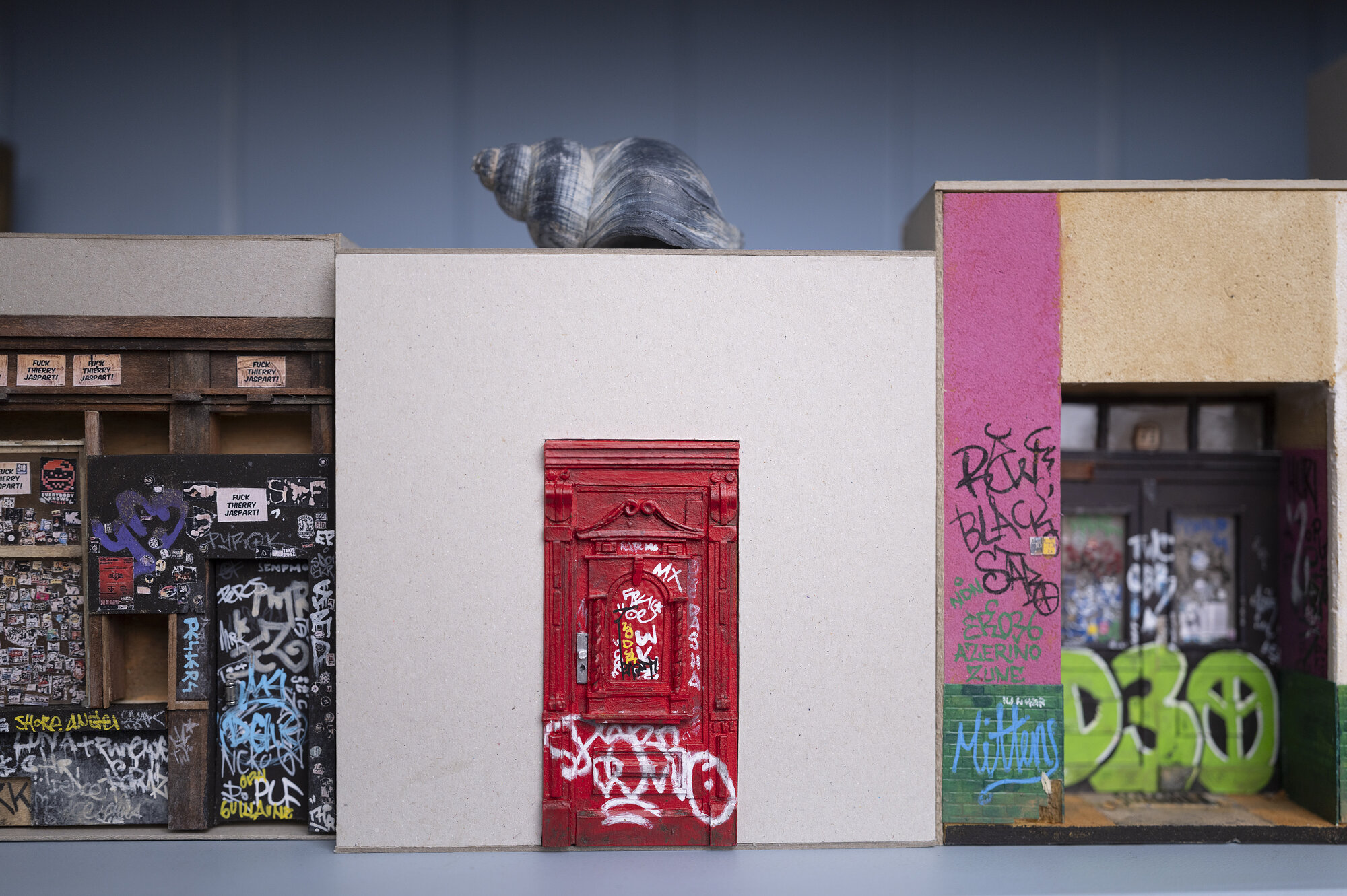
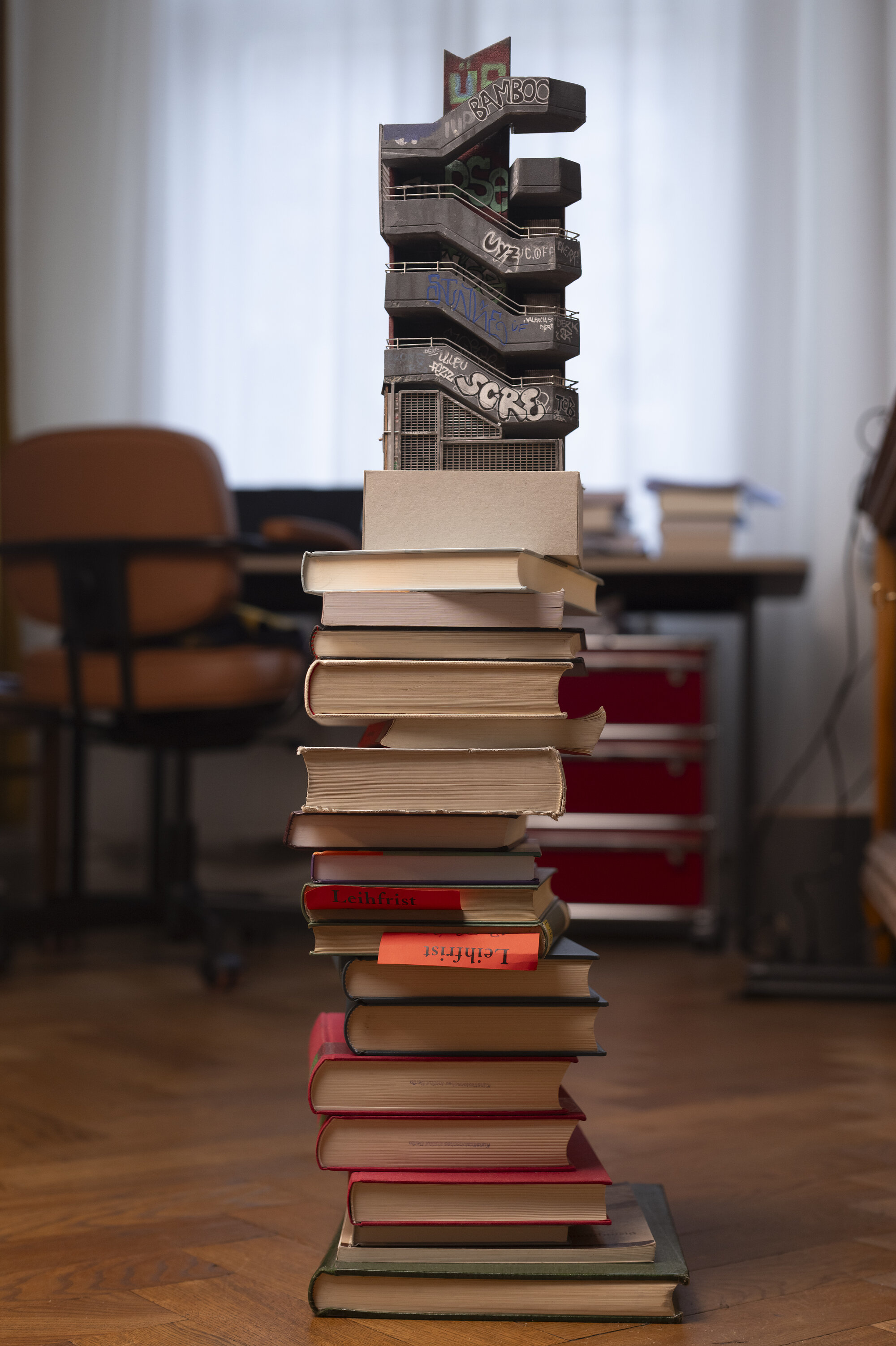
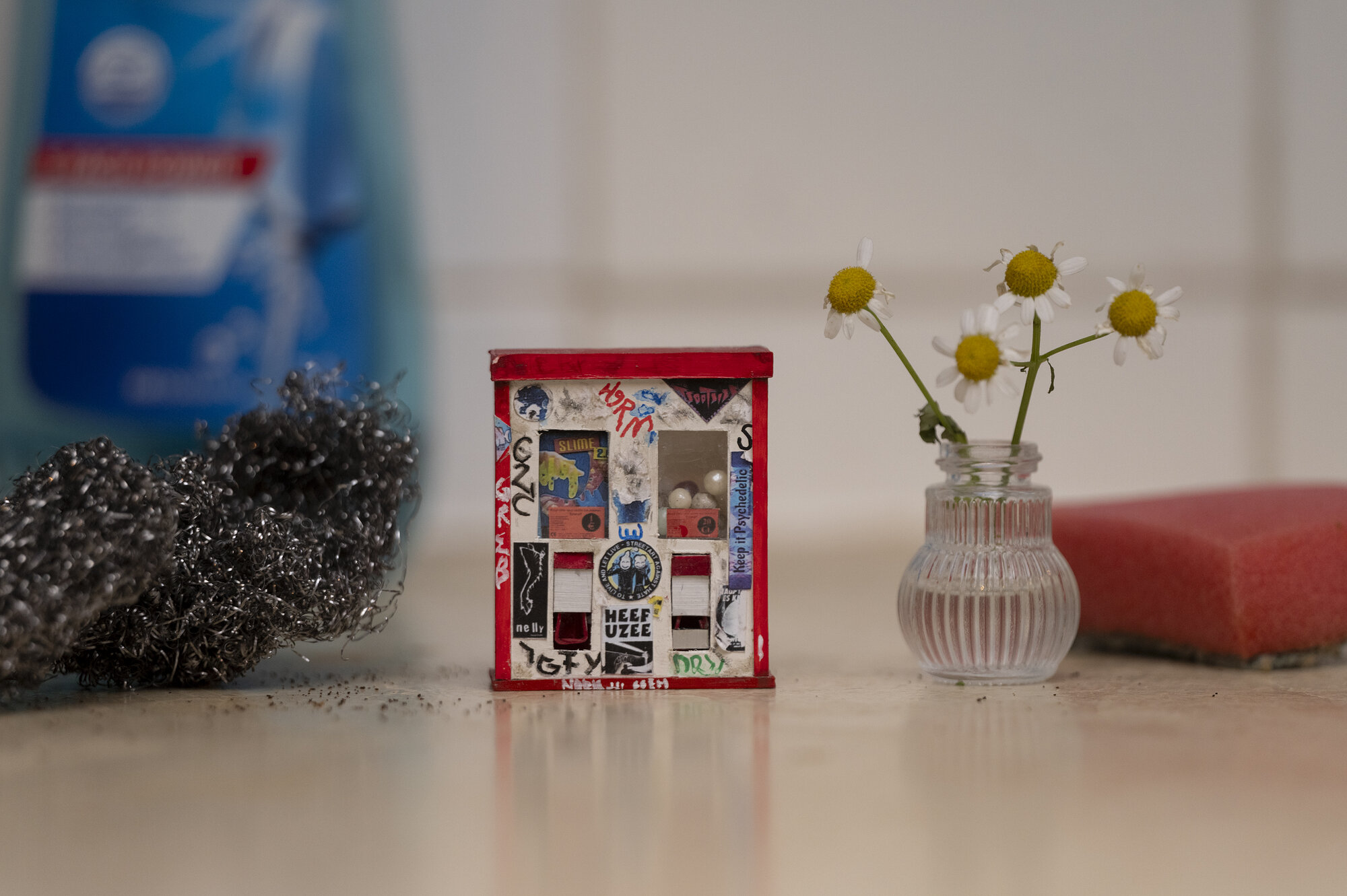
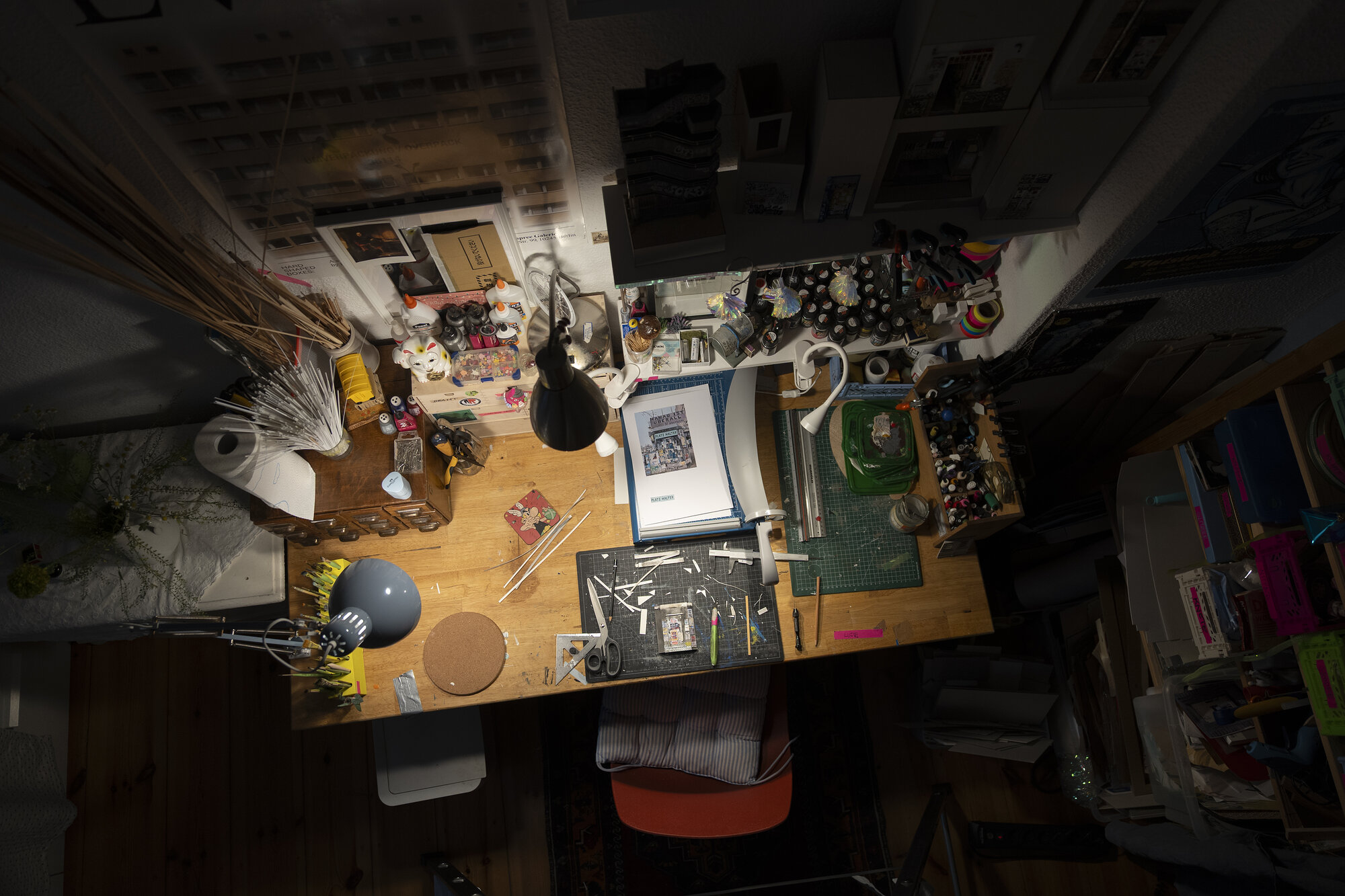
As to the pictures: The miniature atelier is Franziska Neumann’s second workplace. Here she takes a close – and quite artistic – look at today's cityscapes.
Near London’s Millennium Bridge there is a portion of the Thames riverbed that lies exposed at low tide. You can climb down and walk along where the water would usually be flowing. The Braunschweig historian Franziska Neumann enjoys doing just that. As she walks, instead of taking in the sights of the city to afford an entirely different perspective, Neumann takes in the ground underfoot. “You tread the remnants of past centuries that the Thames has preserved,” she explains. “Construction rubble, brick fragments and lots of other shards.” Now on one of the shortest days of the year she sits here in the Wissenschaftskolleg’s bay-window room, which the sinking winter sun bathes in a warm red light, and she enthusiastically relates the surprises and insights that her research project has never failed to supply her with. Franziska Neumann is interested in waste management, and during her time at the Wissenschaftskolleg she wants to write a book on how eighteenth-century London dealt with its refuse. At the start of her project she was chiefly interested in latrines. In the early modern period, how did people actually go to the toilet and what then happened to the contents of the latrine? But soon she widened her research to encompass how people handled waste of every sort.
After completing her doctorate at the Dresden University of Technology, Neumann moved to the University of Rostock and then a fellowship took her to London. “With 650,000 inhabitants, London was the largest city in eighteenth-century Europe, a globally linked commercial metropolis,” says Neumann. “If you want to tackle the issue of waste, then it’s in a large city like this.” Along with the remnants that excavations have already brought to light – “Archeology is the discipline of refuse!” – in the city’s museums she found images depicting rubbish in the streets and marketplaces, then in the archives a trove of administrative documents. She discovered entire discourses on the topic of waste, its uses but also its dangers. “Once you start looking,” she says, “you find the subject everywhere.”
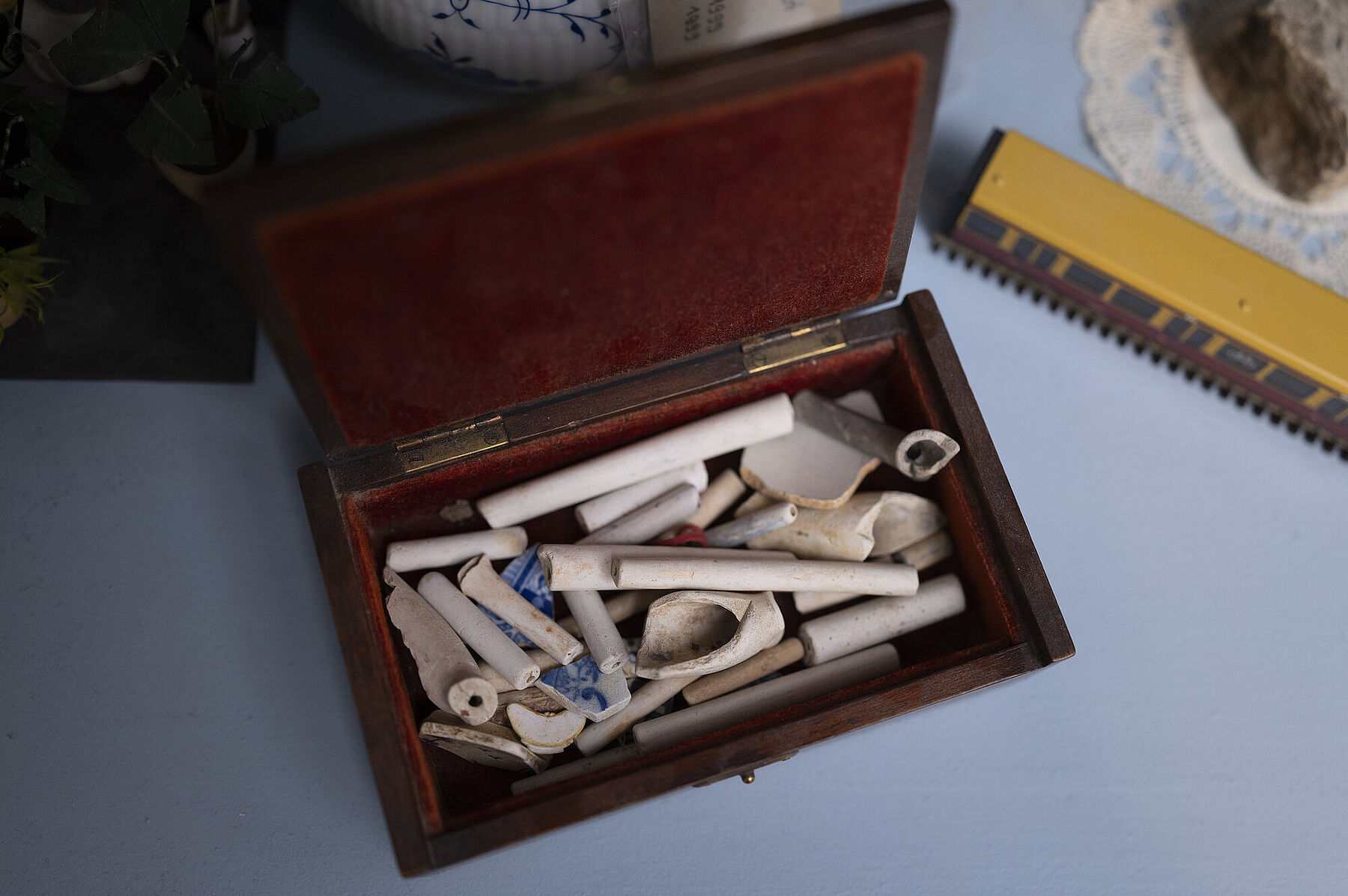
Also in the Thames. The first time that Neumann walked along its riverbed, she was puzzled by all the white finger-sized tubes sticking out everywhere among the historic debris. But her roommate was an art historian and she solved the mystery – they were the remains of clay tobacco pipes. “These little tubes are the cigarette butts of the early modern period,” Neumann explains. “Smoking was all the rage in the mid-eighteenth century. These pipes were mass-produced, they weren’t made to last. You could buy them pre-filled with tobacco, smoke them and throw them away.” In taverns they ended up on the floor, or in walking about one might just toss them in the Thames among other places.
Neumann was amazed: “Disposable products – that didn’t fit with my conceptions of waste management during the early modern period.” In the archives she found documentation of an early modern discussion that also felt oddly contemporary. It concerned “sweepings” or unsaleable commodities. “Under customary law,” she explains, “dockworkers could appropriate tea or sugar that had gotten dirty or wet in transit. But in the mid-eighteenth century you had the problem that these remainders were accruing to the point where they were then resold in a kind of shadow economy. So merchants started systematically destroying these leftovers. That of course reminds me of today’s discussions about dumpster diving. I found that sensational – there was the same debate in the eighteenth century!”
It soon became clear to Neumann that her research project would not only be about waste and its management but about questioning our often idealized images of the past. “We have this notion that everything used to be better, that it wasn’t a throwaway society and everything was recycled, that we took a wrong turn at some point and now have to get back to that earlier state. But in looking at the past we see it’s more complicated than that.” So the history that Neumann is writing will focus on the Janus-faced nature of waste – as both refuse and a resource.
“Wherever people live together, waste accumulates,” says Neumann: ashes from the hearth, offal and other kitchen waste, fecal matter, broken objects that are no longer usable or wanted. Especially in cities, lots of waste accumulates in a confined space, and of course it can’t just lie around stinking and obstructing traffic. That’s as true today as it was in the early modern period. In London, by the mid-seventeenth century, there was already a weekly pick-up of household garbage.
Twice a week the dustman paid a visit, says Neumann, ringing his bell and the servant girl bringing a crate or basket filled with ashes out to him. Dustmen were wage laborers who worked for a raker, a kind of waste-disposal contractor who applied to the city for concessions to collect the household refuse. Londoners paid a tax for this service – and they demanded their money’s worth. If a dustman missed his rounds then there was a barrage of complaints, which Neumann uncovered in the archives: “People took rather accurate notes: ‘No ashes collected for three weeks!’”
Additionally, there were numerous “recycling specialists” who collected certain kinds of refuse and turned it to account; ragpickers bought or gathered scraps of cloth that were needed for paper production; and responsible for the latrines – into which “non-recyclable waste” was often thrown – were the nightmen who came by that name because they performed their duties after dark to spare people the stench. “One of them would climb down into a pit and shovel everything out,” details Neumann. “It was execrable work and dangerous due to the gases.” Apart from municipal trash disposal and the specialized collectors, there were plenty of second-hand markets where used items could be sold.
What some wanted to discard was a valuable resource for others. The ash was brought to landfills and sold to brickworks where it was mixed with clay. The city was growing, it needed bricks, and ash was in such demand that ash-thieves disguised as dustmen – so-called flying dustmen – collected it illegally. “This clearly shows that certain waste materials like ash were so lucrative that a variety of players vied for it,” says Neumann. “There was also discussion as to whether human excrement might be used as fertilizer. But it’s hard to tell whether that was actually effected.”
Because of such practices, the early modern period is often recruited as an exemplary model of how recycling should be done. Neumann thinks this is going too far: “It forces a complex subject into the Procrustean bed of a modern perspective.” She prefers to focus on the values, norms and knowledge systems that shaped the treatment of waste as both refuse and a resource – and on those people who performed the labor.
“Of course a lot was recycled,” she confirms, “but that was only possible because many people sorted and processed waste materials for a starvation wage and under miserable conditions. And these were typically not the people who benefited from recycling. A history of recycling in the early modern period is also a history of social inequality and poverty, so hardly a model for the present.
That’s also true for London. But not only. “Waste-disposal contractors such as the rakers and nightmen could achieve a modest prosperity through garbage,” says Neumann. “One would think that these men were part of the underclass, but they were more middle class, not wealthy but owning a certain amount of property. They weren’t social outcasts – they even aggressively advertised their services.” Recycling didn’t happen because people wanted to be nice to the environment; rather, trash was in demand and you could earn your living with it.
The values that shaped the consumption and management of refuse and resources in the early modern period were influenced by a Christian ethic of thrift and moderation. “You were supposed to be frugal and not wasteful, while also living in accordance with your status and social rank. The mending and darning of textiles was considered a good thing, many women acquired these skills, but there was a difference between mending and going about in rags. One had to know the difference,” explains Neumann, who in fact sees a more interesting connection to the present day in this value system than in recycling. “Today we ask ourselves what our own responsibilities are in a consumer society. What do we buy and how much? Then as now it isn’t a question of all or nothing, black or white, but shades of gray.”
Moreover, consumer cultures underwent a change in the eighteenth century: people had more possessions – such as ceramics and textiles – which became finer due to new forms of production and hence more fragile and potentially less durable. “Any history of waste in eighteenth-century London is just as much a history of maidservants carrying ashes out to the dustman’s cart as it is a history of waste entrepreneurs making a profit from recycling,” says Neumann. “It is a history of waste avoidance but also of broken teacups. Recycling was certainly an important part of early modern waste management, but it’s ultimately just a sole perspective on waste.”
Asking how waste is handled can disclose much about a city – which is also why Franziska Neumann finds the subject so stimulating: “There are so many interesting aspects and phenomena, the topic is like a prism or magnifying glass held up to urban society. You learn about the organization of households, about municipal responsibilities, infrastructure, the social tectonics of a city.” In criminal records, for instance, she found true-life accounts of dustmen who came into houses and then nicked certain objects when the servant girl stepped out to fetch them a beer.
And Neumann repeatedly finds her topic resonating with students, colleagues and even those from other disciplines: “I’m at a technical university and scholars from other departments are more than happy to engage me on the subject of waste. I’ve never had someone wrinkle their nose – instead they immediately say: Of course, it’s an important topic!” She has had a similar experience at the Wissenschaftskolleg. “The exchange with other Fellows is exciting, they all have a strong desire to understand what the others are working on. I’m certain that I’ll leave here with a wealth of new ideas for my book.”
And in her book you will vainly search for early modern solutions to the current problems of our throwaway society. “But to say that everything back then was completely different and has no bearing on the present is also wrong,” she asserts. “In history we don’t find any directives for action today, but looking at the early modern age helps to enrich current debates with historical depth. This historical perspective allows for a reflective distance and in the best case can help to challenge our modern assumptions.”
More on: Franziska Neumann
Images: © Maurice Weiss