



Issue 10 / June 2015
"Cute is the New Beautiful"
by Hans-Joachim Neubauer
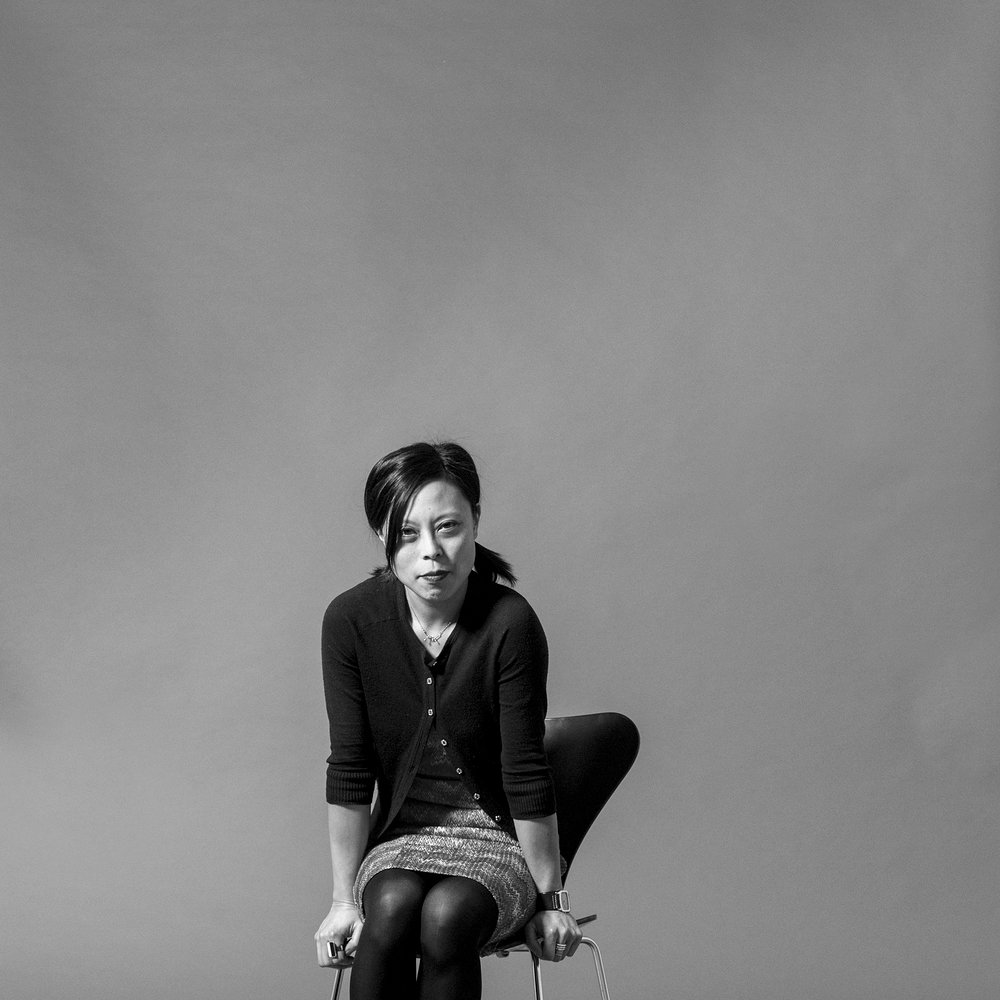
The American literary scholar Sianne Ngai investigates aesthetic judgments in our everyday life
“And what exactly is this?” asks Sianne Ngai. She regards the little thing in the palm of her hand. “It looks like something useful, but essentially it’s a plastic dingus in the form of an apple, in pink. On top is a plastic flower in yellow, pink and green, and it moves.” The flower does indeed beckon with its leaves, powered by a photocell. “I don’t know what that’s for,” ponders Sianne, “perhaps it’s only there to attract our attention. It looks at us and inquires: ‘Do you like me?’ Extremely irritating!” She looks merrily about. Any more gimmicks around?
At our first meeting at the Wissenschaftskolleg, Sianne Ngai spoke of all the little items that instantly appear wherever tourists are to be found, places where everything should be nice and fun. Where does one interview a modern intellectual who pursues research into gadgets and gimmicks? In the German Museum of Technology? In the GDR Museum? We finally decided for the Mall of Berlin on Leipziger Platz, a symbol of the triumph of consumerism over city planning. A really gimmicky place!
On the way there, we chat about smoking in Berlin and the clubs she has been to. And about Dewey her dog. He has tagged along from Stanford to be at his mistress’ side in Berlin. Ngai looks around. “It’s so American!” she exclaims and laughs. Welcome home!
That was ten minutes ago. Carefully, as if she were handling a little piece of Meissen porcelain, Ngai places the surreal plastic apple back on the shelf. The flower twitches a couple times more – “Do you like me?“ – then it finally gives up and its leaves just droop. “For instance in America we have a banana-slicing machine,” says Ngai as her gaze takes in the big-eyed stuffed animals, mirthful keychains, brightly patterned coffee cups – to which some of Berlin’s primest real estate has been assigned. “Banana-slicing machines – do you have such things here?”
Gimmicks entice people with a promise – for example as work-saving devices. What else is a banana-slicing machine good for? “Gimmicks are things or technologies that let us see through them. They show us just how they do what they do.” And they make the logic of how they produce their intended effects transparent – this is what a famous Berlin flâneur and philosopher might have said had he ever encountered the surreal flower with its idiotic twitching. Gimmicks foster ambivalent feelings. A person takes note of them with sympathy and experiences a brief moment of joy in recognizing that certain surprising idea which they bring to light. At the same time however one feels disgusted; these gimmicks might, from a purely theoretical standpoint, save time and energy, but they are also cheap. They are technoid reminders of the surplus and of the superfluous. No one really needs them. And so that cheap things can be cheap they need to be cheaply manufactured; and to be cheaply manufactured, you need low wages and machines. Cheap things, cheap people, twitching flowers. “And the cheaper the machines that we sell as gimmicks, all the more certain is the fact that they have been built by machines which are cheaper than human labor.”
Our Aesthetic Categories: zany, cute, interesting – this is the title of Sianne Ngai’s second book. After a long search we finally find a quiet seat in an ice-cream parlor. Malls are exhausting – particularly when they contain so much zany, cute and interesting stuff. “?Cute? is a way of infantilizing someone, of trivializing them,” says Ngai. “?Cute? is a response to aesthetic impotence!” And what is so remarkable about that? There have to be words for things that are cute, sweet and innocuous. Yes, says Sianne Ngai, but “cute” is not just any word, it is used excessively, you read and hear it everywhere, and “?cute? also has its dark side. The more power we have over something that is ‘cute’ then the ‘cuter’ it appears to us.” As for sweet, “you simply want to devour it,” says Ngai. At a neighboring table a woman in a dark jacket is speaking circumspectly to her male companion; now and again she looks our way and nods her head with a knowing smile.
Ngai is serious – “cute” does indeed deal with the consumption of a commodity. And the issue of gender is involved here as well. Already Edmund Burke equated beauty with womankind, says Ngai, with powerlessness and speechlessness. “Cuteness is our new beauty,” she opines. The meaning and significance of “cute” can only first be understood in the context of issues of power. It is a strategy for making those things aesthetically alluring which are impotent and surmountable. Just think of all those stuffed animals hanging from the rucksacks of adult men and women, those “funny” stickers on suburban family cars, those “ironic” jokes about the boss on coffee cups at the office. Things which are sweet and innocuous implicitly peddle the notion that those people who surround themselves with such objects are themselves innocuous. In other words, someone who has a cuddly teddy bear clinging to their backpack must themselves be sweet and cuddly. But as once did the gremlins, so too are the stuffed animals expanding their sphere of influence. They dangle triumphantly from cell phones and have conquered electronic communication in their capacity as grinning emoticons – the horror.
Has Ngai herself ever been called cute or zany? “Good question,” she says and unleashes that bright laugh of hers. “As a child I wore these big glasses and was pretty small, but no one found me particularly sweet.” And she didn’t want to be thought of as sweet, she recalls – though sometimes she did since being sweet ultimately meant a kind of integration, namely in a secure aesthetic schema. Conflicted feelings. “As a woman, as an Asian, who grew up in the United States, I was always dealing with ascriptions such as cute,” says Ngai and then speaks of the “low-level” racism that she grew to know as a child. She contends that she became aware of race as a central issue in her life before that of gender. Born in 1971, she grew up with her two sisters in Virginia. Her parents, both Chinese immigrants, made each other’s acquaintance in Chicago, her father a mathematician and her mother one of the few women in her generation in America to be awarded a PhD in chemistry.
“I’m a woman from the South.” For Ngai the American South begins in Baltimore, not far from Washington, D.C. and its ethnic diversity. “There were simply racist structures in place,” says Ngai, yet the commonplace everyday racism that she encountered was “not that bad,” she was never physically threatened. All the same: “It did leave its mark on me to a degree.” Sianne the young girl already had conflicted feelings. And conflicted are the concepts that the scholar today associates with words such as “cute”, “zany” and “interesting”. “Cute” is a term of endearment and aggression; “interesting” conveys intellectual involvement and aesthetic indifference verging on boredom; “zany” implies delight and strain.
The word “interesting” is what we almost automatically say when we wish to take a position regarding a certain fact or event. As opposed to “cute,” it reserves all aesthetic judgment. It will often serve to express uncertainty or a sense of ambiguity. A person who declares that something is interesting is actually saying: Give me some time to form a judgment. “Interesting” is the dog-eared page of daily communication, a bookmark of social interchange, an invitation to discuss things further. The word provokes an inquiry. Just why is something interesting? What makes it so special? A remark leading to a conversation. The word “interesting” is also an example of Bronislaw Malinowski’s and Roman Jakobson’s “phatic communion” whereby a “bond of commonality” is created. Speaking becomes a social act.
In such a context the word “interesting” is a call to action. What does Kant say? “The delight which we connect with the representation of the real existence of an object is called interest.” („Interesse wird das Wohlgefallen genannt, das wir mit der Vorstellung der Existenz eines Gegenstandes verbinden." A part of this delight is an “appetitive faculty” – that is to say that interest means action, that interest is the precursor to a discourse. By contrast, for Kant, any judgment of taste with regard to the beautiful is based on a “purely disinterested delight.” Cute is the new beautiful and interesting means: Ask me something!
The woman at the neighboring table sends another conspiratorial smile our way. Annoying A change of subject: Why is her dog called Dewey? “It’s from the headline ‘Dewey Defeats Truman’,” explains Ngai. This is what the Chicago Daily Tribune prematurely and erroneously reported in the November 1948 presidential election between the Republican Thomas E. Dewey and the incumbent Harry S. Truman, who afterward laughingly held up the paper and its legendary headline for photographers. Sianne Ngai’s dog is an ironic four-legged reminder of the joy of smoking out mistakes.
And what about the word “zany”? This quintessentially American word has the sense of funky, freakish, crazy – and it reflects the production process of items that grin maniacally at customers while giving a kooky and almost hysterical account of the frenzied conditions of their manufacture. These stressful conditions are carried forward in the stressful merry-go-round of objects in both analogue and digital department stores. The mall in which we are sitting is filled with tokens of a consumer society gone haywire – ripped jeans and t-shirts with shrill messages, polyfunctional timepieces and all the buy-this-and-be-yourself appeals that simultaneously manifest the strain entailed in the manufacture of such things so that they will be noticed, purchased and consumed. And it is in this clash of marketing stimuli that the costly and valuable items also find their place – when everything is so hyperactively happy the understated design of a stylish luxury watch gives some idea of what an effort it takes in appearing effortless.
This has consequences for the production of such items. “In the post-industrial present, enterprises are increasingly teaching their employees to regard their work as fun,” explains Ngai. Private life and work life interpenetrate one another, particularly in the service sector. “Whether in a restaurant, a bank or a plane, service providers work to make us feel comfortable.” And many of these always flexible so-called atmo-workers are women – they smile, create a pleasant atmosphere and foster a relaxed working environment. It’s back-breaking work to produce the commodity “feelings”. Work is emotionalized; the word “zany” also conveys this transformation.
Beautiful, sublime, ugly – Sianne Ngai is attempting to expand the canon of aesthetic categories. This literary and cultural scholar is often asked if it’s fun doing research on words like “zany”, “cute” and “interesting” – and if she actually likes gimmicks. “No one says that you have to love what you study,” says Ngai. “I analyze these words and items and that’s all there is to it.” Is there life without gimmicks? She laughs once more, then she has to go – Dewey awaits. All the best, see you later!
Now the woman at the neighboring table takes the stage: “Excuse me, you were doing this interview, you were talking with that woman.” – “Yes? And?” – “I think I know her. She’s some kind of model! Or is she an actress? She’s from the States, right?” – “What tipped you off?” – “Well, I’m nobody’s fool,” says the woman and leans back with self-satisfaction in her chair. “A star in our mall – that’s crazy!“
More on: Sianne Ngai
Images: © Maurice Weiss