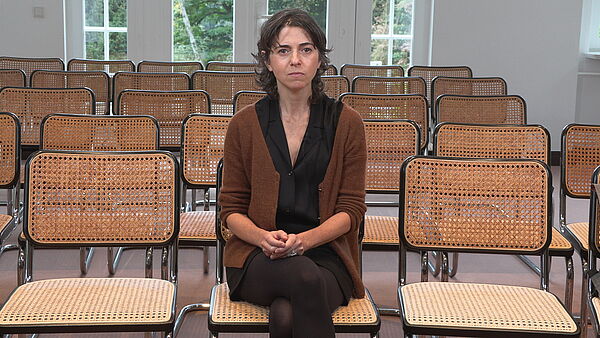
Erica Weitzman, Ph.D.
Associate Professor of German
Northwestern University, Evanston
Born in 1975 in Washington, D.C., USA
B.A. in English and French, College of William and Mary, M.A. in Creative Writing, Boston University, M.A. in Liberal Studies, The New School for Social Research, Ph.D. in Comparative Literature, New York University
Project
Bluster: Bourgeois Anxiety and Expository Style in Mid- to Late Nineteenth-Century Germany
My project investigates a strangely dominant, yet up to now largely unexamined style in mid- to late nineteenth-century German letters: a paradoxical combination of bombast, avuncularity, belligerence, and petulance that I, taking a cue from the first of Friedrich Nietzsche’s Untimely Meditations, designate with the name of “Gepolter”—or, in English, “bluster.” Proceeding from this text of Nietzsche’s—a scathing review of the last book of the renegade theologian and recent convert to scientific materialism David Friedrich Strauss—and moving to the larger scope of nineteenth-century German intellectual and popular culture (in particular, the critical polemics of the young Karl Marx and the humorous novellas of Wilhelm Raabe), my project considers the ideological and affective implications of this style—as well as the accusation of practicing it—as at once a form of self-legitimation and a response to a legitimation crisis. Bluster, as I hypothesize, is the rhetoric of male bourgeois fragility in the age of the bourgeoisie’s apparent triumph, an unconscious defensive strategy in the face of the feared loss of cultural and political power at that power’s tenuous height.My project analyzes the elements and effects of this strategy in light of the conflicted complacency of much of nineteenth-century German culture already diagnosed by Nietzsche: the mixture of anxious epigonism and preemptive defensiveness of the supposed victors of the end of history, which only barely hides both the precariousness and the violence that such a victory implies. In this way, my project aims to excavate the cultural, psychological, and political valences of a tone nearly ubiquitous at the time, but rarely considered in and of itself, with clear consequences for the understanding of public rhetoric up to and including the present day.
Recommended Reading
Weitzman, Erica. Irony’s Antics: Walser, Kafka, Roth, and the German Comic Tradition. Northwestern University Press, 2015.
—. At the Limit of the Obscene: German Realism and the Disgrace of Matter. Northwestern University Press, 2021.
Colloquium, 20.01.2026
Notes on Bluster
What is bluster? What kind of tone, genre, style, form, mood, affect, speech act, or rhetorical mode does it describe, what kinds of effects does it create, what purposes, beliefs, and subject positions does it entail, and what are the historical conditions of its development and practice? In my colloquium, I will seek to answer some of these questions: not, however, by establishing a taxonomy or conclusive definition of bluster, but rather by considering a particular moment and milieu in which bluster, or anyway something that could be called bluster, seems to be ubiquitous, namely, in the intellectual debates of mid- to late nineteenth-century Germany, both before and after the March Revolutions and the eventual founding of the German Kaiserreich. As I observe, from the philosophical brawls of the Young Hegelians to the establishment public intellectuals of the German Empire (and, alas, beyond), a peculiar and paradoxical combination of smugness, bombast, sarcasm, and thin-skinned petulance quickly emerges as the dominant tone of educated middle-class discourse, one that, I suspect, says as much about the content and context of that discourse itself as about the psychologies of its authors.
In my talk, I will sketch out some of the background, scope, and methodological challenges of my project, and present three case studies by which to both clarify and flesh out my ideas. In the end, I may even offer a provisional description of bluster, but one that attends to its changeable sociohistorical implications and conditions of possibility.
Publications from the Fellow Library
Weitzman, Erica (Philadelphia, PA, 2025)
Realism as theory : Erica Weitzman and Tove Holmes
Weitzman, Erica (Philadelphia, PA, 2025)
Las things : Raabe's materialism
Weitzman, Erica (Evanston, Illinois, 2021)
At the limit of the obscene : German realism and the disgrace of matter
Weitzman, Erica (Evanston, Illinois, 2015)
Irony's antics : Walser, Kafka, Roth, and the German comic tradition
Weitzman, Erica (Paderborn, 2015)