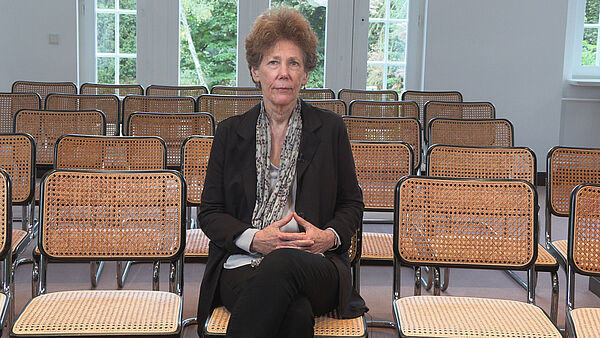
Sally Sedgwick, Ph.D.
Professor of Philosophy
Boston University
Born in 1956 in Los Angeles, Cal., USA
BA in Philosophy, University of California, Santa Cruz, Ph.D. in Philosophy, University of Chicago
Project
Temporality and Method in Hegel’s Phenomenology
In his 1807 Phenomenology of Spirit, Hegel argues that we can identify stages in the journey of modern Western consciousness and describe its steps towards maturity in the form of a temporally ordered narrative. This is one respect in which temporality figures in the Phenomenology. In my proposed project, however, I am concerned with how Hegel ties temporality to the nature of knowing itself. A principal aim of the Phenomenology is to expose the illusion of the Cartesian assumption that we can start inquiry from nowhere and sweep history wholly aside. Hegel seeks to persuade us that all knowledge, including self-knowledge, is indebted to the road we knowers have travelled. In defending the thesis that all thinking is anchored in and responsive to history, Hegel challenges still persistent assumptions about the possibility of presuppositionless knowing.In his Phenomenology, Hegel notes that, in his tale of the progress of consciousness through various forms of knowing, he will rely on a “philosophical” or “scientific” method of cognition, a method he distinguishes from its “mathematical” counterpart. He notes in an intriguing remark that “pure mathematics … does not set time, as time, over and against space as the second material [Stoff] for its study.” Mathematical cognition is “dead,” in Hegel’s characterization, insofar as it is inattentive to process and treats its most basic concepts as “fixed” or “lifeless.” Mathematical cognition is “dead,” in addition, insofar as it is insufficiently self-critical. Because it asserts its definitions as immediately certain or established, mathematical cognition closes itself off to the possibility of further development.
Part of my project will involve exploring Hegel’s account of the nature of concepts. To what extent are they “plastic” or “dialectical,” in his view? In addition, I will consider how he understands the conditions of self-critical inquiry. Must such inquiry be absolutely presuppositionless? Is presuppositionless inquiry even possible? My suspicion is that Hegel doubts that wholly presuppositionless inquiry is possible because he is persuaded that even our most abstract and self-critical acts of thinking are anchored in history.
Recommended Reading
Sedgwick, Sally. Kant’s Groundwork of the Metaphysics of Morals: An Introduction. Cambridge University Press, 2008.
—. Hegel’s Critique of Kant: From Dichotomy to Identity. Oxford University Press, 2012.
—. Time and History in Hegelian Thought and Spirit. Oxford University Press, 2023.
Colloquium, 09.12.2025
Weltgeschichte als Weltgericht: Justifying Hegel’s World History and "Philosophy of Right"
What can Hegel mean when he asserts in his Philosophy of Right that world history is “a court of judgment [Gericht]”? As he characterizes it, world history refers not to a domain of bare or unfiltered facts, but to the “narrative [Erzählung]” that the historian or philosopher of history constructs in her reflective consideration of events and institutions of the past. Hegel claims, in addition, that his world historical narrative is a rationally justified “science,” rather than an expression of mere opinion. His ambition to replace opinion with rational justification seems dubious, however, if only because his grand narrative looks suspiciously self-serving. My intention in this essay is not to argue that Hegel’s treatments of the history of right and of world history leave nothing important out, nor do I suggest that his narratives are free of bias. Instead, I defend the thesis that Hegel’s conception of the scientific nature of his enterprise requires him to be receptive to charges of this kind.
Publications from the Fellow Library
Sedgwick, Sally (New York, NY, 2025)
Does philosophy need to know its history?
Sedgwick, Sally (Oxford, 2023)
Time and history in Hegelian thought and spirit
Sedgwick, Sally (Padova, 2020)
Two Kantian arguments for the speculative basis of our science of nature
Sedgwick, Sally (Hamburg, 2018)
Innere versus äußere Zweckmäßigkeit in Helgels Philosophie der Geschichte