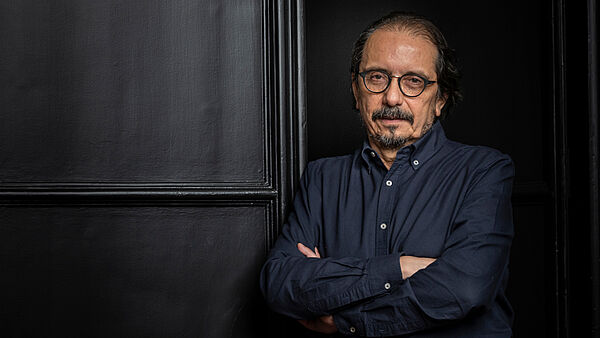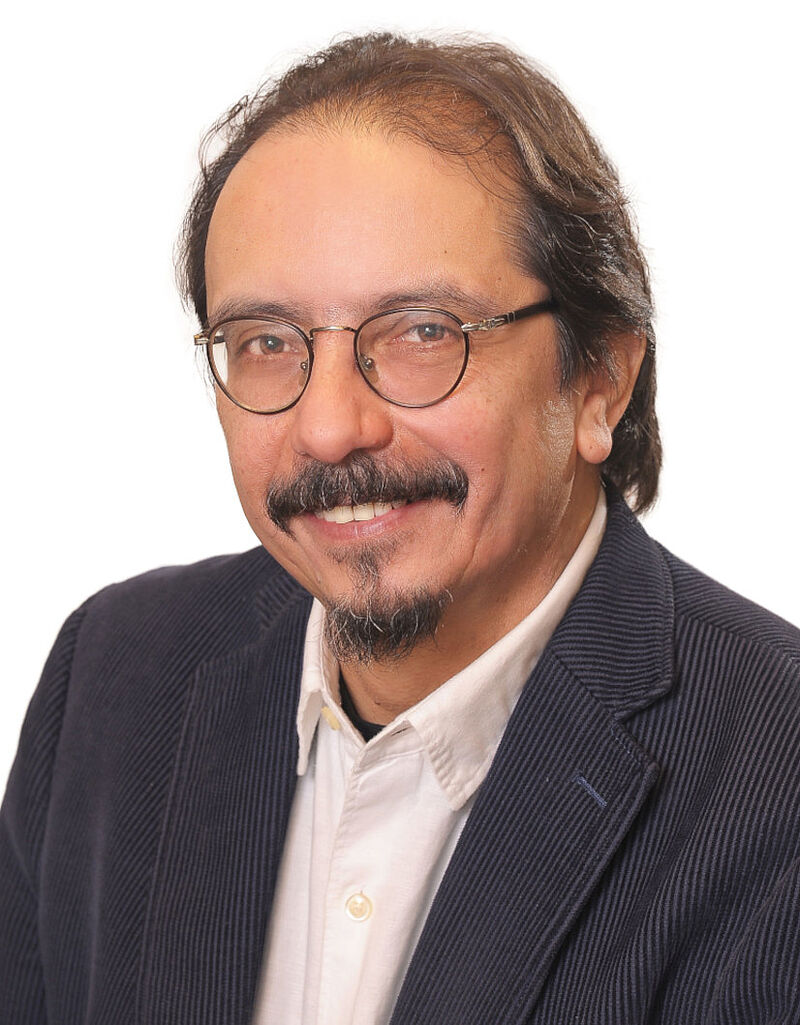
Pablo A. Marquet, Ph.D.
Professor of Ecology
Pontificia Universidad Católica de Chile
The Santa Fe Institute
Born in 1963 in Santiago
Ph.D. in Biology, University of New Mexico
Project
Universal Ecology. Understanding Life from Cells to Societies
Ecology is fundamental to understand the phenomenon of life from cells to societies. The origin of life is the origin of an ecology; it is the origin of a biosphere and our way of being in the world. We argue that what unfolded from there can be understood only if we do away with the levels-of-organization paradigm and view from a different perspective: what unfolds for life is a recurrent process guided by the first principles underlying energy, matter, and information flows. The details of this dynamic and its manifestation in different phenomena—from cells to ecosystems and societies—form the core of the research I will undertake at the Wissenschaftskolleg and that will become a book on the subject. This book is foremost a synthesis of works I have done during the last 30 years and also a source of original research ideas. Among the former are the issues of general laws underlying the structure of ecological systems, manifesting in recurrent mathematical objects or relationships, such as scaling laws or invariant distributions characterizing dynamics, and accounting for observables such as the distribution of species richness, species abundances, genes in populations, and gene families in genomes. Among the latter are the fundamental role of neutrality and realized fitness symmetry, the fundamental role of stochasticity and birth and death dynamics, the role of key environmental factors such as temperature in affecting ecological patterns from cells to ecosystems, and the universal character of these effects. The most important new insights provided by the book arise from the blending of ecology, math, physics, economy, philosophy, and sociology that runs through it. Importantly, we mount an organized attack aimed at deconstructing the metaphysics of the level-of-organizations paradigm and propose a different epistemological stance. The end result is a radical philosophical view on how to interpret ecological dynamics, including the human phenomenon, society, and its relation to the rest of the natural world.Recommended Reading
Marquet, Pablo A., Andrew P. Allen, James H. Brown, et al. (2014). “On Theory in Ecology.” BioScience 64 (8): 701–710. https://doi.org/10.1093/biosci/biu098.
Marquet, Pablo A., Guillermo Espinoza, Sebastian R. Abades, Angela Ganz, and Rolando Rebolledo (2017). “On the Proportional Abundance of Species: Integrating Population Genetics and Community Ecology.” Scientific Reports 7: 16815. https://doi.org/10.1038/s41598-017-17070-1.
Arroyo, José I., Beatriz Díez, Christopher P. Kempes, Geoffrey B. West, and Pablo A. Marquet (2022). “A General Theory for Temperature Dependence in Biology.” Proceedings of the National Academy of Sciences 119 (30): e2119872119. https://doi.org/10.1073/pnas.2119872119.
Colloquium, 05.05.2026
Ecology from cells to societies
Ecology is the science of interaction among entities manifested in fluxes of energy, matter, and information. These characteristics are present across levels of organization, and their understanding provide a framework to develop simple efficient theories based on first principles. In this talk, I will elaborate on a couple of case studies showing how those processes that affect energy, matter, and information fluxes explain patterns from cells to societies, from individual growth, abundance to social complexity by what I call the socio-ecological loop.
Publications from the Fellow Library
Marquet, Pablo A. (Washington, DC, 2026)
Explaining the universality of biological thermal responses
Marquet, Pablo A. (Washington, DC, 2022)
A general theory for temperature dependence in biology
Marquet, Pablo A. (Mittweida, 2017)
On the proportional abundance of species : integrating population genetics and community ecology
Marquet, Pablo A. (Berkeley, Calif. [u.a.], 2014)
Marquet, Pablo A. (2014)
A continuum of specialists and generalists in empirical communities
Lectures & Keynotes 04/28/26