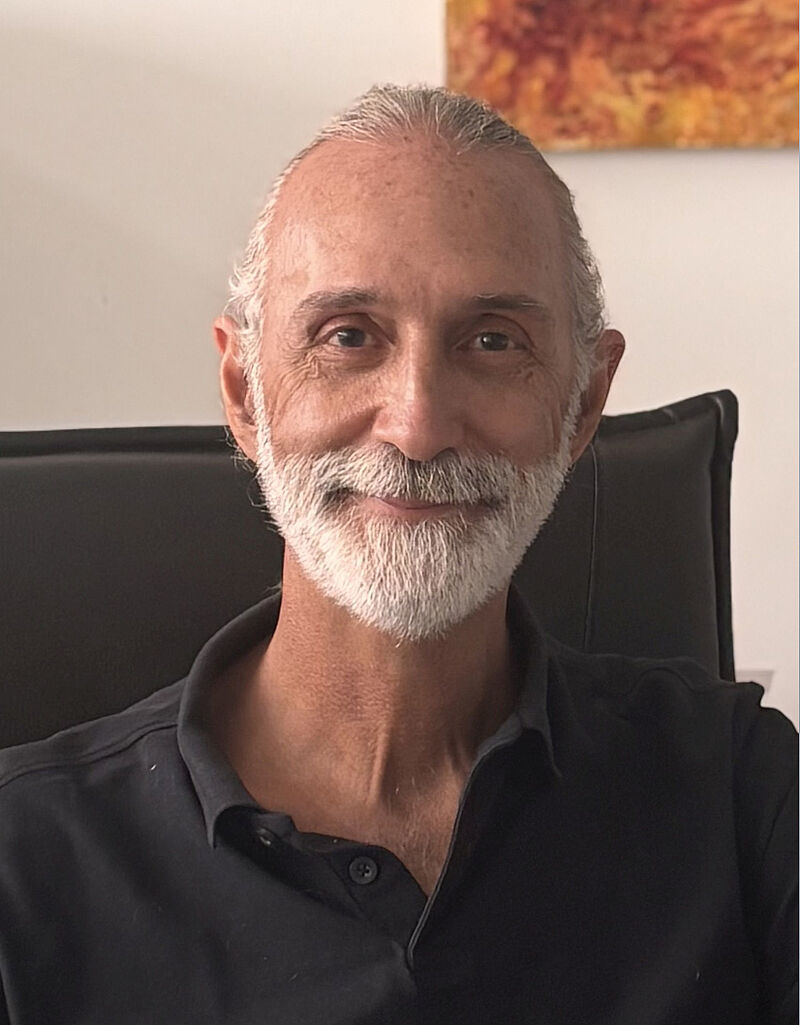
Walter Marcelo Farina, Dr.
Professor
University of Buenos Aires
IFIBYNE-UBA-CONICET, Buenos Aires
Born in 1962 in Buenos Aires
Licenciado and Dr of Biological Sciences, University of Buenos Aires
Project
Basic and Applied Knowledge for Understanding Complex Biological Systems: Social Bees as a Model in Integrative Biology
As pollinator-dependent crops continue to expand globally, effective pollinator-management strategies are needed to meet the increasing demand for pollination services. The scope and challenges of implementing crop-pollination strategies based on the behavior of one of the most widely managed pollinators, the honeybee, have been recently documented across various commercial crops. Honeybees’ ability to perceive, learn, and generalize floral odors, their foraging preferences following olfactory experiences, and the transfer of food-source information within the social context of the colony are all key factors influencing foraging decisions. These aspects are particularly relevant when attempting to direct pollinators toward target crops. Building on decades of research, we have developed a platform of crop-specific odor mimics that enhance the activity of treated colonies and increase crop yields. On the other hand, these insects are increasingly exposed to disturbed agroecosystems, where agrochemicals are applied in concentrations that can impair their social organization, cognitive capacities, and survival. The honeybee is considered a sentinel species due to its high sensitivity to environmental changes. Using a range of experimental approaches, we have identified biomarkers that allow the diagnosis of alterations in intensive agricultural landscapes. How to improve global productivity without compromising biodiversity and the environment remains an open question. Addressing this challenge requires connecting basic and applied research across different realms of knowledge. Such integration can emerge from multidisciplinary dialogue. This fellowship is an excellent opportunity to synthesize existing evidence and develop new perspectives.Recommended Reading
Farina, Walter M., Christoph Grüter, and Paula C. Díaz (2005). “Social Learning of Floral Odours Inside the Honeybee Hive.” Proceedings of the Royal Society B 272: 1923–1928. https://doi.org/10.1098/rspb.2005.3172.
Farina, Walter M., Andrés Arenas, Paula C. Díaz, Cinthia Susic Martin, and M. Cecilia Estravis Barcala (2020). “Learning of a Mimic Odor Within Beehives Improves Pollination Service Efficiency in a Commercial Crop.” Current Biology 30: 4284–4290.e5. https://doi.org/10.1016/j.cub.2020.08.018.
Macri, Ivana N., Pablo J. Moja, José M. Latorre-Estivalis, Diego S. Cristos, Jorge A. Zavala, and Walter M. Farina (2024). “Agricultural Intensification Impairs Behavioral Abilities and the Expression of Genes Associated with Social Responsiveness in Honeybees.” One Earth 7 (9): 1569–1586. https://doi.org/10.1016/j.oneear.2024.07.012.
Colloquium
Pollinators and Sentinels in Anthropogenic Landscapes
Honeybees (Apis mellifera) occupy a paradoxical position in anthropogenic landscapes. As managed pollinators, they contribute directly to agricultural productivity; as biological sentinels, their health reflects the cumulative effects of agrochemicals, nutritional stressors, pathogens, and environmental disturbance. This dual role places honeybees at the intersection of the three interdependent dimensions that frame the One Health concept – animal health, ecosystem health, and human well-being – making them a valuable model for examining One Health in contemporary agroecosystems. The talk connects two complementary lines of research: the use of honeybee learning, olfactory perception, and social information transfer to improve crop pollination, and the analysis of how disturbed agroecosystems affect honeybee social organization, cognition, and survival. Bringing these lines together shows how managed pollination, environmental monitoring, and ecosystem resilience can be treated as connected processes rather than separate problems. The central question is how agricultural productivity can be improved without further compromising biodiversity and environmental health.
Publications from the Fellow Library
Farina, Walter Marcelo (London, 2026)
Young honey bees Apis mellifera learn to avoid pollen contaminated with glyphosate or imidacloprid
Farina, Walter Marcelo (London, 2025)
Farina, Walter Marcelo (New York, NY, 2025)
Sugar response and gustatory gene expression in the stingless bee Tetragonisca fiebrigi
Farina, Walter Marcelo (Amsterdam, 2025)
Farina, Walter Marcelo (Amsterdam, 2025)
Detoxification response in honey bee larvae exposed to agricultural intensification
Farina, Walter Marcelo (London, 2024)
Sugar-conditioned honey bees can be biased towards a nectarless dioecious crop
Farina, Walter Marcelo (Basel, 2024)
Farina, Walter Marcelo (Pittsburgh, PA, 2024)
Identification of chemosensory genes in the stingless bee Tetragonisca fiebrigi